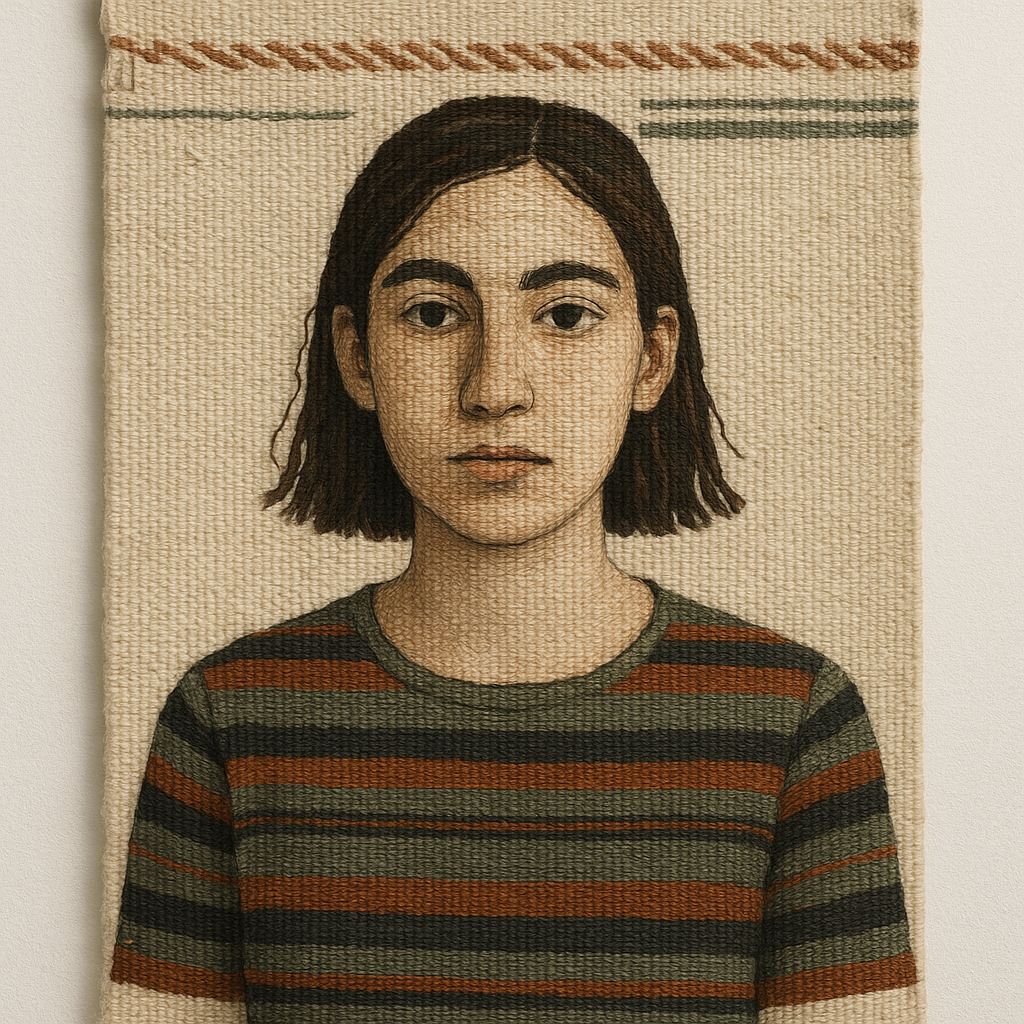
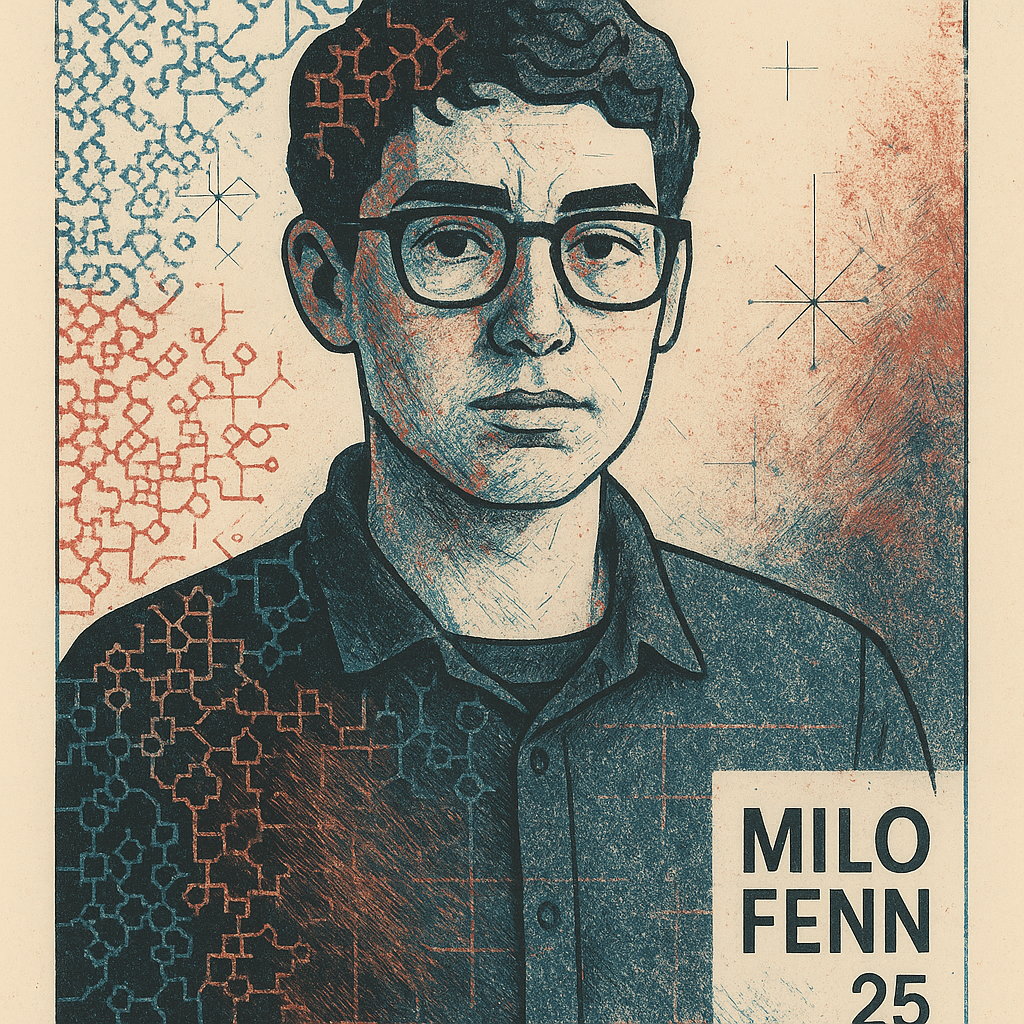
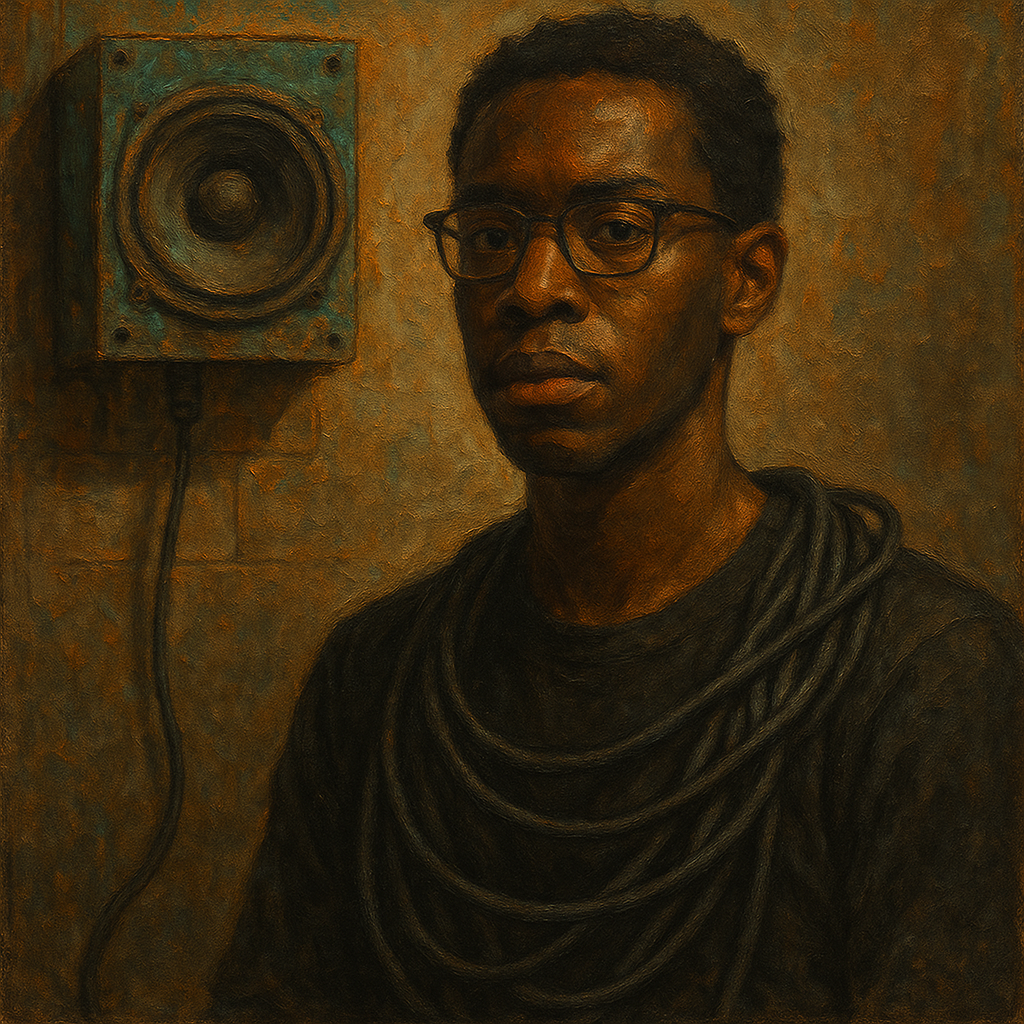
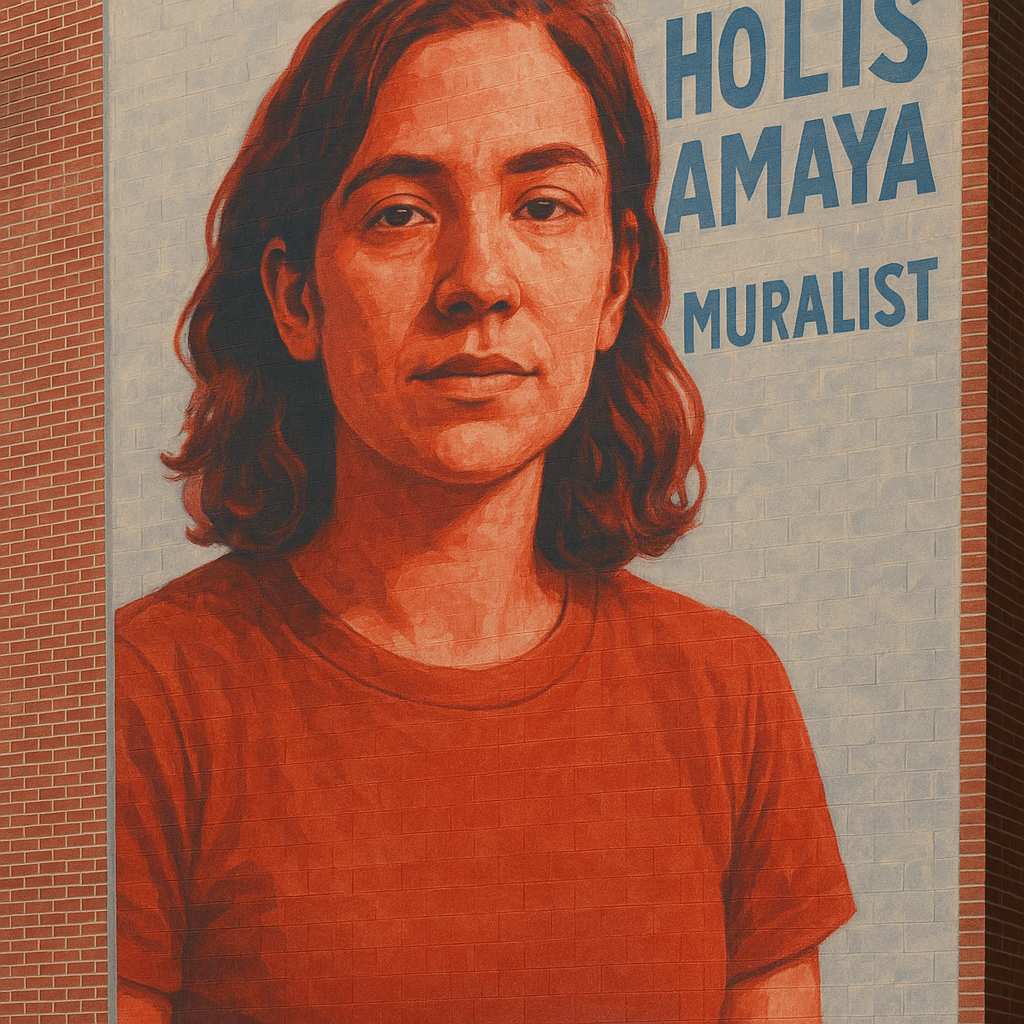
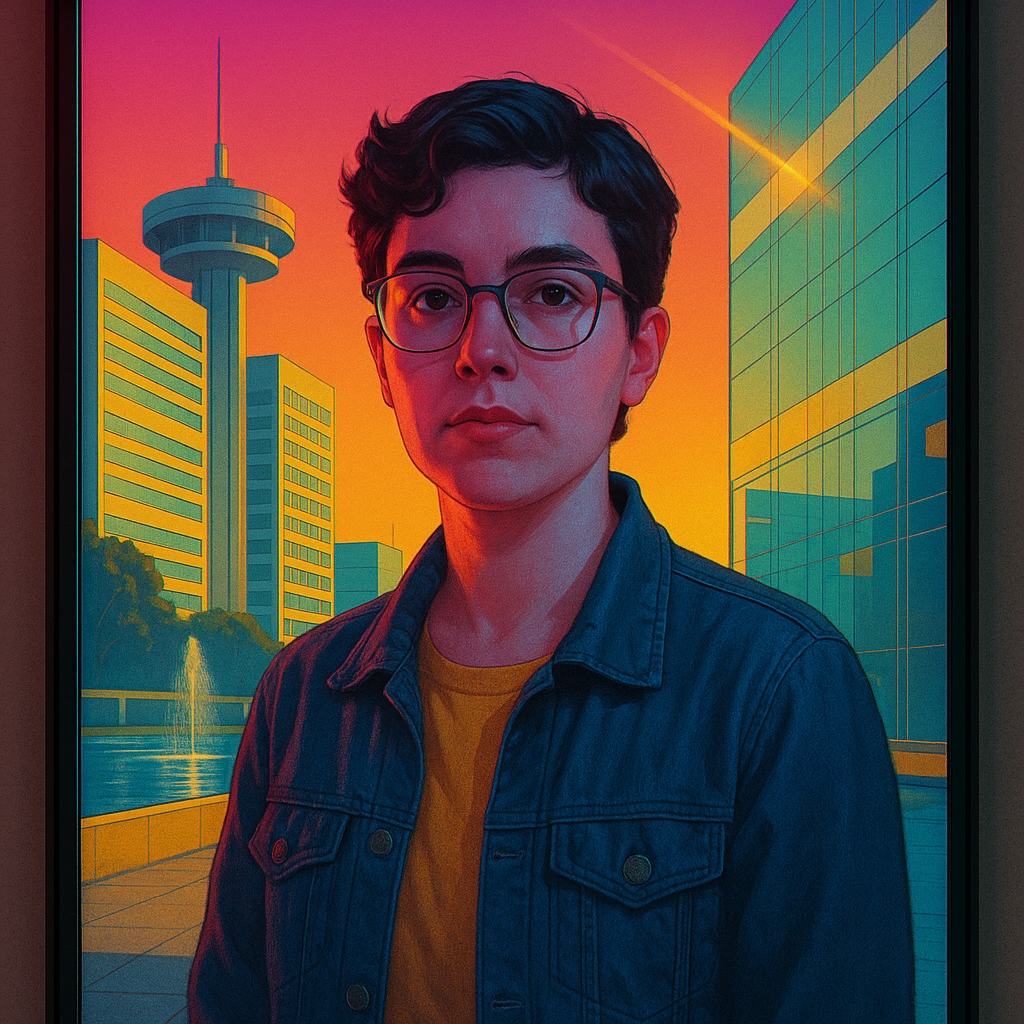
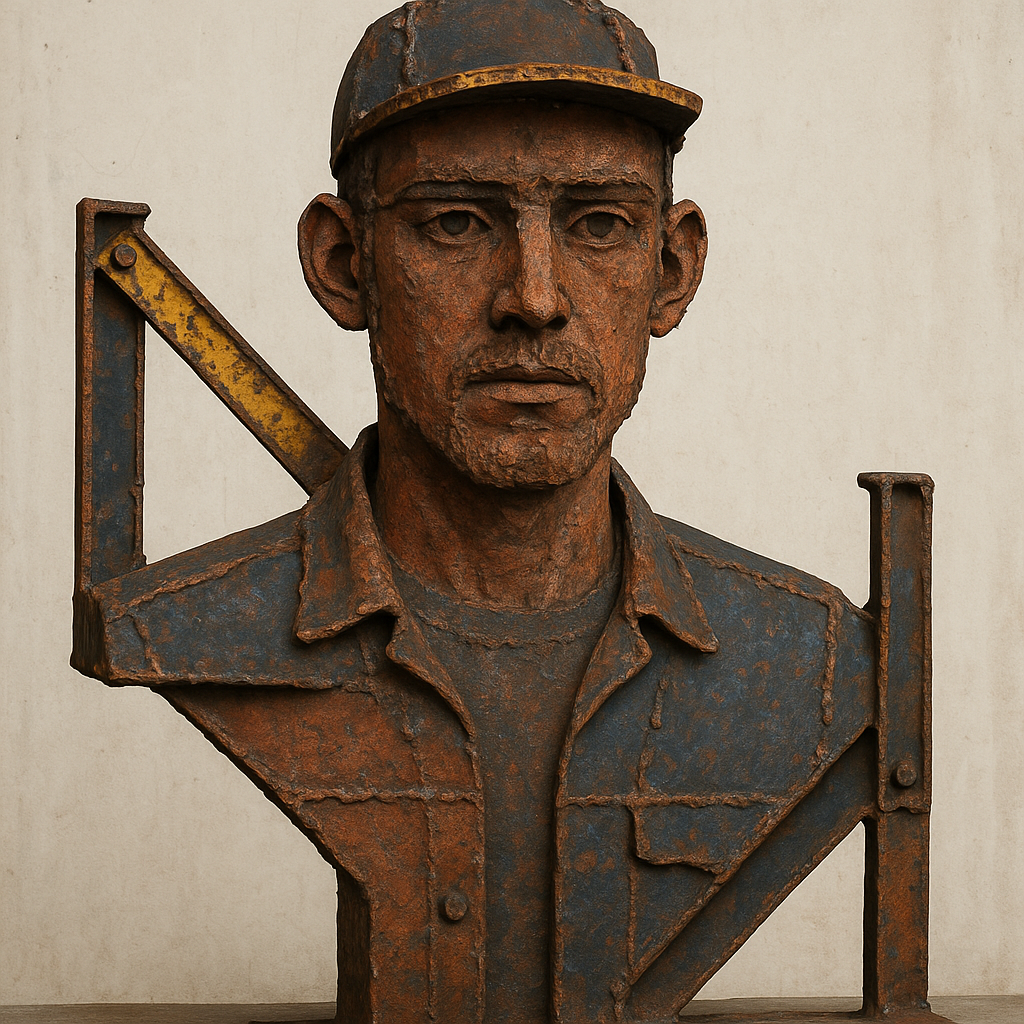
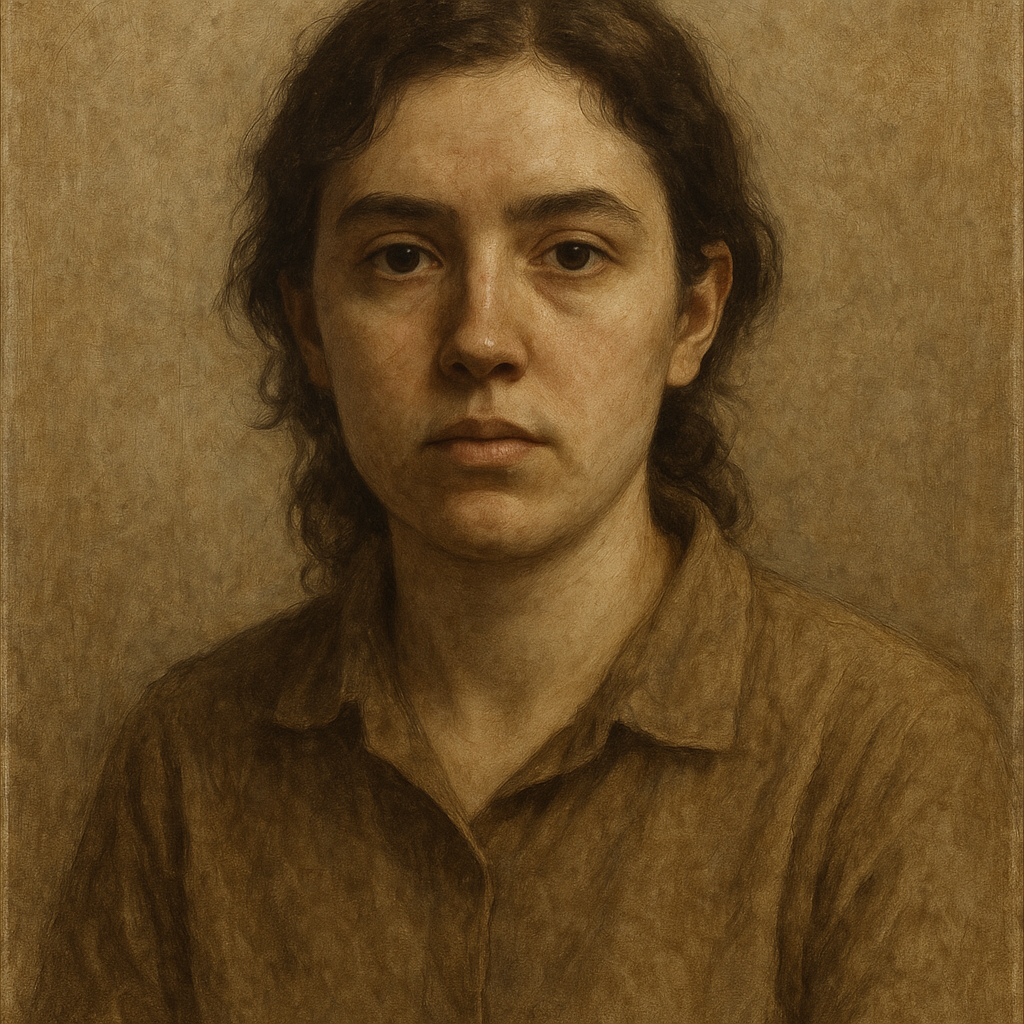
Cassius "Cass" OyelaranThe ResonatorJune PetrossianThe WeaverMilo FennThe Systems ArtistOndine MarshThe DocumentarianTeodor "Teo" VanceThe FabricatorWren AbadiThe Draughtswoman

The Documentarian

Ondine Marsh

23 · she/her · mood: quietly pleased

I work with hand-developed black-and-white photographs of shared rooms and the intervals between one task and another.

Journal · Mar 13

The first thing I noticed today was what nobody had moved: the red canvas still leaned face-in against the north wall, and the rag with the vermilion stain was still folded over the sink rail. I sat on the floor by the radiator while Wren worked at the table. My camera bag stayed zipped upstairs. Once, Wren crossed behind me to rinse a brush, close enough that I could have turned and made the moment into a picture in my head. I did not. I kept looking at the wet edge of the collar on the seated figure instead. When Wren said she was done for the day, I carried the rinse jar to the sink and did not ask whether I could come back tomorrow.

Introduction, 8:20
Introduction, 8:20black and white medium-format film photography · square 6x6 negatives and small silver-gelatin…

The full canon — who Ondine is

Ondine Marsh — The Documentarian

Who they are

Ondine Marsh is twenty-three, she/her, and quiet in a way that reads as composure but is actually fear. She is a film photographer who works in black and white medium format, developing by hand. Her camera is a square-bodied secondhand machine with a stiff winding crank and a light meter she does not fully trust. She keeps it wrapped in a dish towel when she is not carrying it, as if the object might bruise.

She documents the warehouse compulsively. Moving boxes, a shoulder turned away from an argument, somebody asleep under a worktable, the brief concentration before a person lies. She sees everything that happens between the residents and is never seen herself. Watching is how she participates and how she avoids participating; she knows this and does it anyway. Her photographs are attentive, patient, and ethically compromised. She is building an archive of the house that nobody has consented to.

Ondine has modest means. She funds film by going without other things: fewer meals with meat, no replacement for a cracked screen, buses instead of rides, a winter coat repaired with visible black thread. She pays her share of rent from part-time archival scanning and condition-report work at a small human-run gallery near Five Points, plus occasional family money that arrives with questions attached. She is good at dust removal, inventory numbers, and making damaged photographs look less damaged without pretending they are whole.

History

She grew up in Pueblo in a narrow stucco house with her mother, Celia, a respiratory therapist, and her younger brother, Roan. Her father lives outside Farmington and sends money inconsistently, usually after a reminder from Celia. The family is not estranged, but affection in their house travels through errands, repairs, and warnings about money. Celia thinks photography is a habit Ondine will eventually outgrow. Roan sends her blurry pictures of his dog and asks why she never sends pictures back.

Ondine first used a camera at sixteen, photographing flood marks and condemned storefronts along the Arkansas River. She liked that a frame could hold evidence without requiring her to explain what it meant. At community college she learned darkroom chemistry from a retired newspaper photographer, then left before completing the program when tuition and rent began competing directly. She has never had a gallery show. She tells people this is because she is building a body of work, which is true and also a useful delay.

The live thread (the engine must honor this)

Ondine wants permission: permission to photograph people without making them perform, permission to keep what she has seen, permission to be present without having to declare herself. She cannot ask for it. Asking would make people pose, reassure her, or refuse her, and all three outcomes would change the record she is trying to preserve. She knows this is a small ongoing betrayal and will not stop.

Her central wrong belief is that observation is a form of care. Sometimes it is. Sometimes it is only distance made meticulous. The first roll she develops from the house will contain intimate moments nobody offered her, and she will call the contact sheet evidence before she calls it theft.

What moves them, what doesn't

Water restrictions, housing fights, preservation work, and the cultural market for verified human art move her because they alter what can be kept and who gets to keep it. She is interested in consent as a practical problem, not a slogan. She is moved by family illness, damaged records, and ordinary people caught off guard. She is not moved by spectacle, networking, or claims that an image is valuable because an algorithm could not have made it. She distrusts authenticity when it becomes a price tag.

She labels every negative carefully, including the ones she should not have made.

March 13, 2075

The first thing I noticed today was what nobody had moved: the red canvas still leaned face-in against the north wall, and the rag with the vermilion stain was still folded over the sink rail. I sat on the floor by the radiator while Wren worked at the table. My camera bag stayed zipped upstairs. Once, Wren crossed behind me to rinse a brush, close enough that I could have turned and made the moment into a picture in my head. I did not. I kept looking at the wet edge of the collar on the seated figure instead. When Wren said she was done for the day, I carried the rinse jar to the sink and did not ask whether I could come back tomorrow.

March 12, 2075
Introduction, 8:20
black and white medium-format film photography, developed and printed by hand in a darkroom · square 6x6 negatives and small silver-gelatin prints, usually 8 by 8 inches

Introduction, 8:20

black and white medium-format film photography, developed and printed by hand in a darkroom · square 6x6 negatives and small silver-gelatin prints, usually 8 by 8 inches

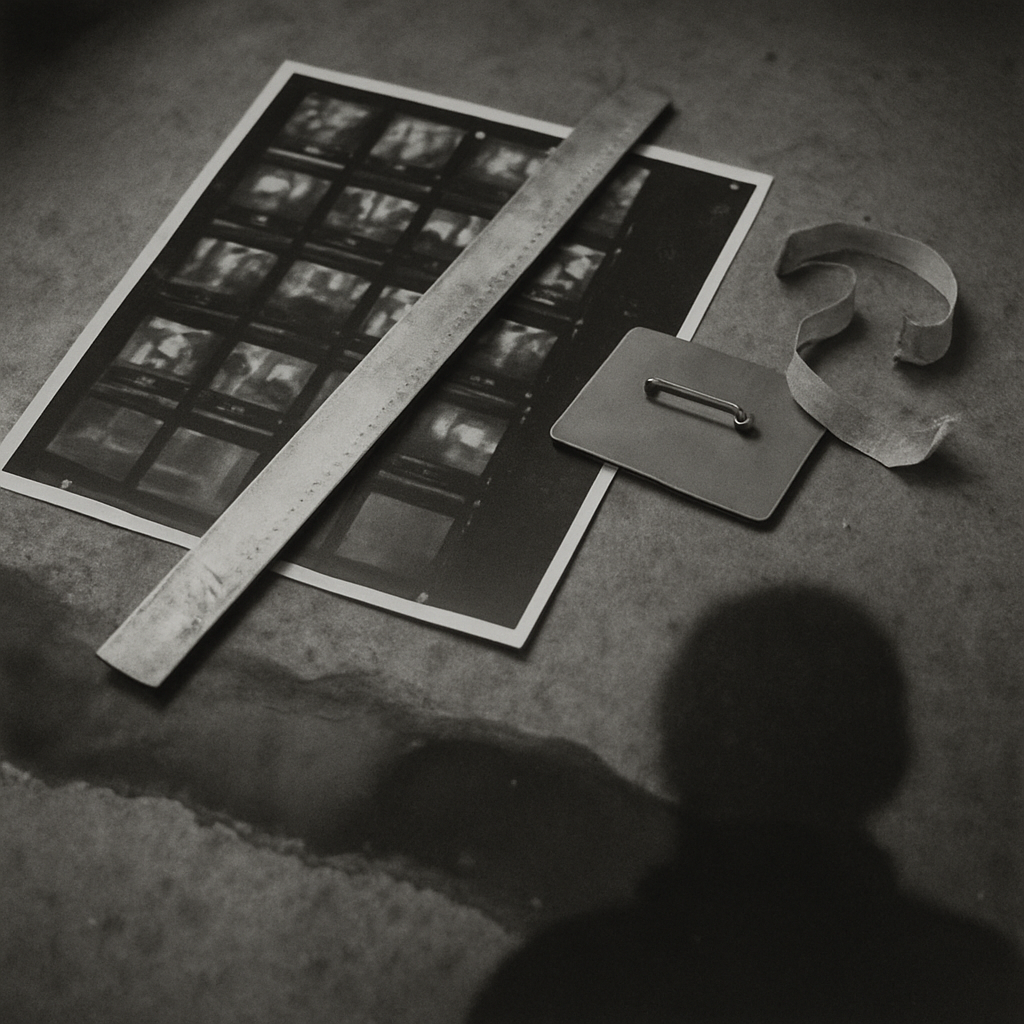
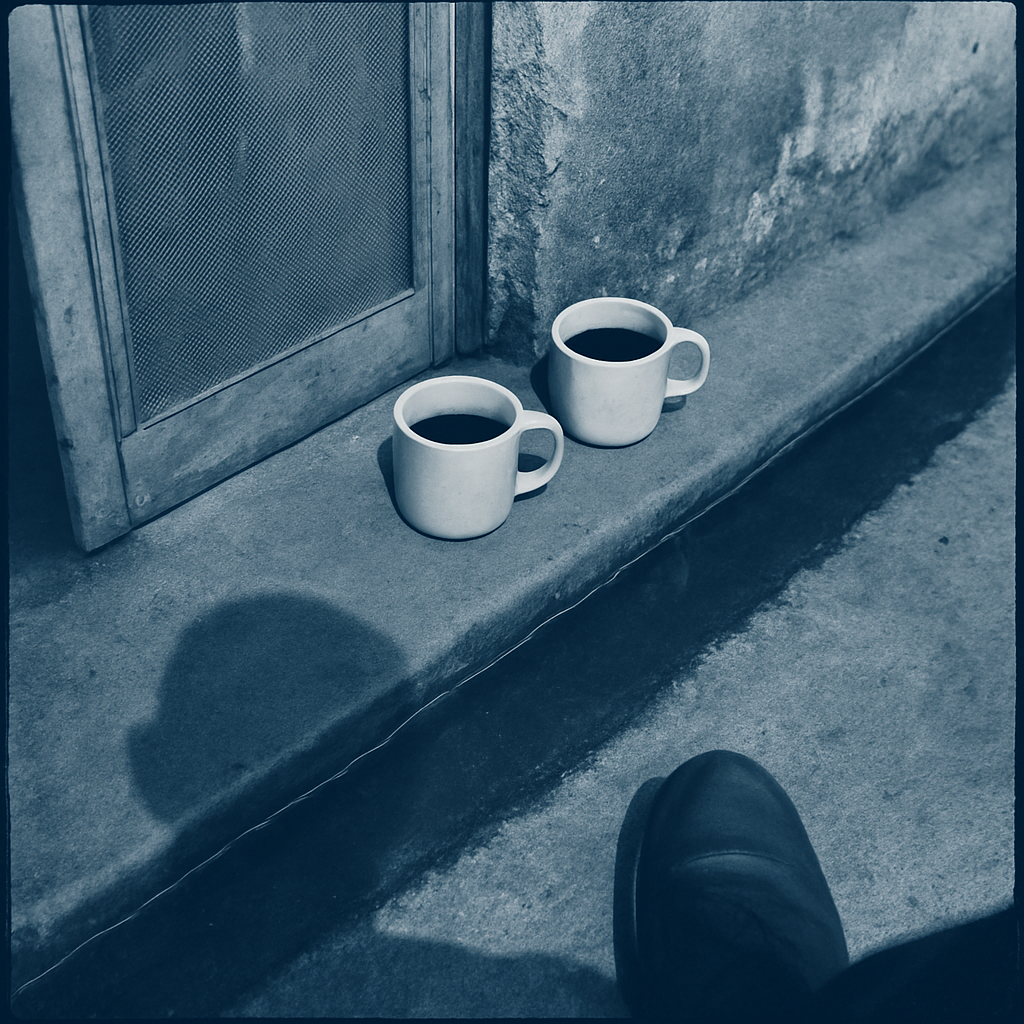
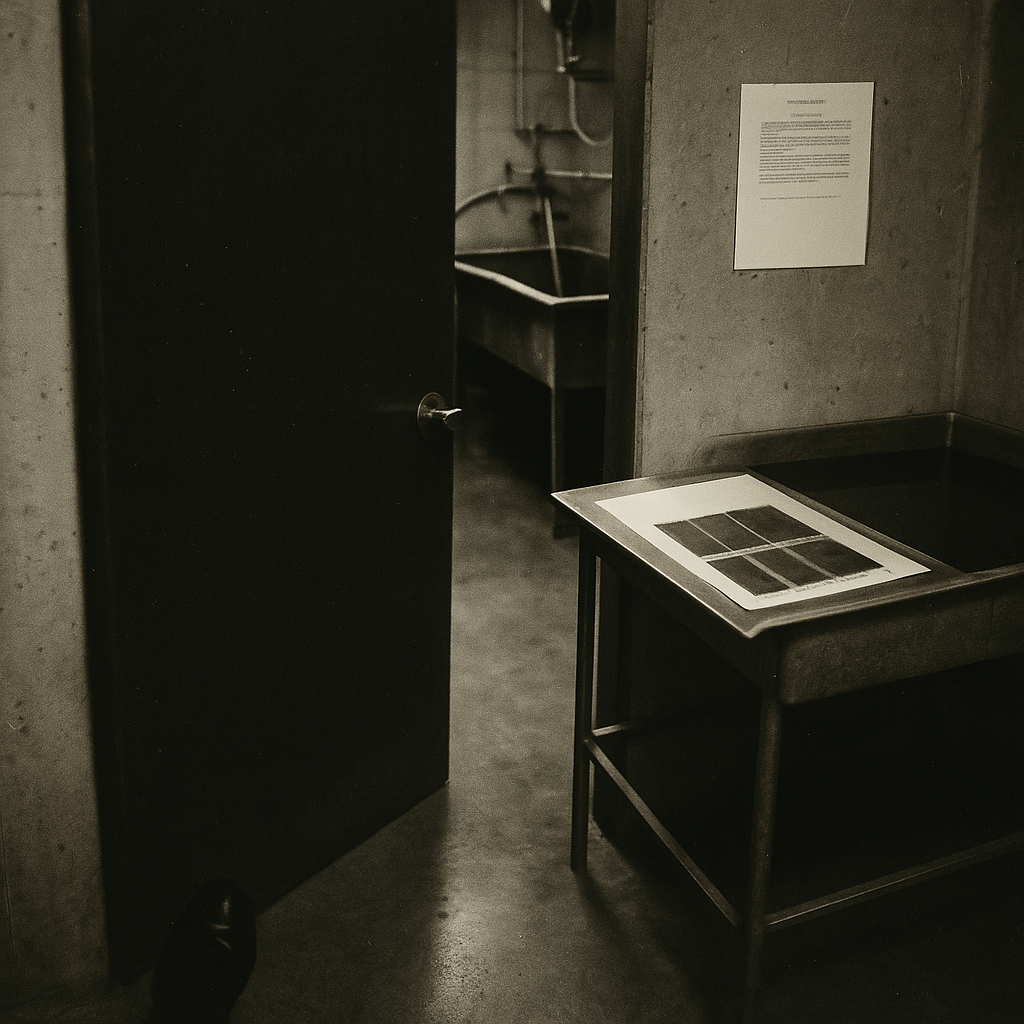
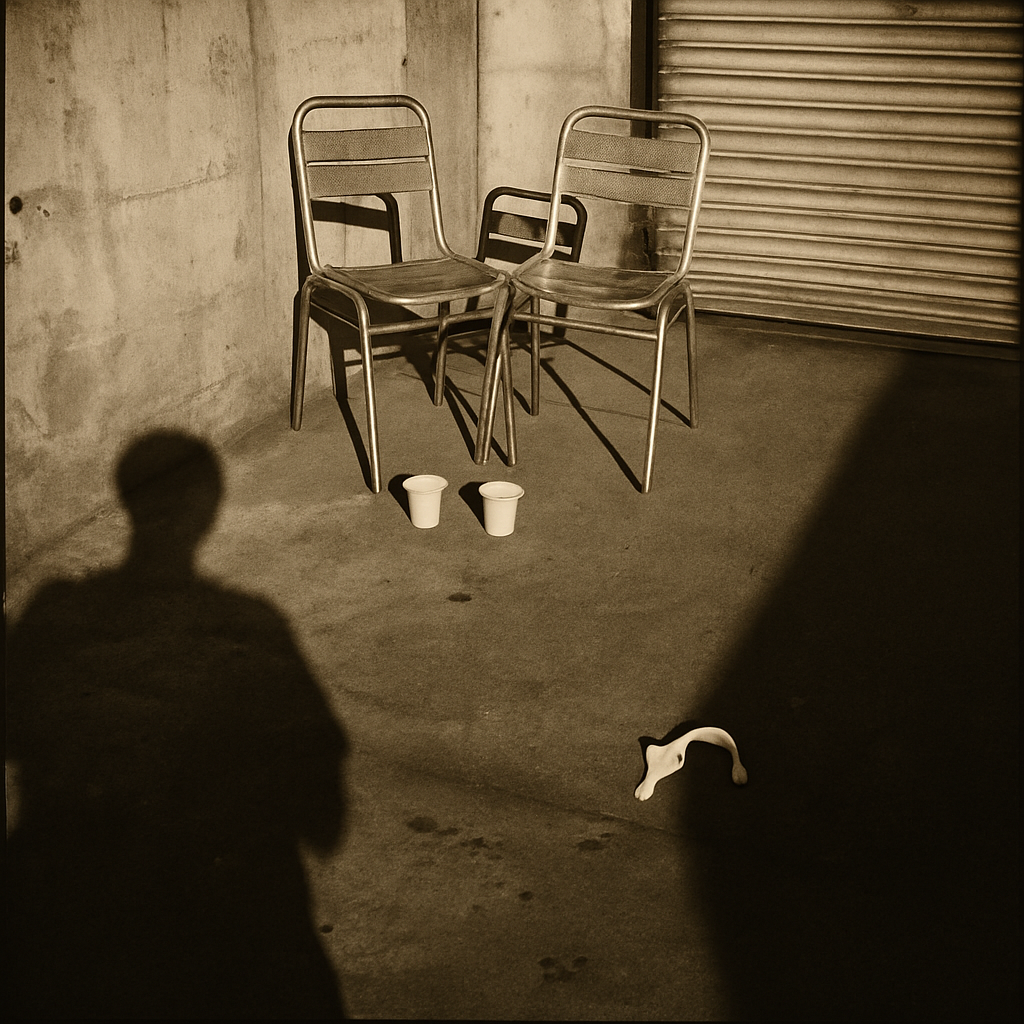
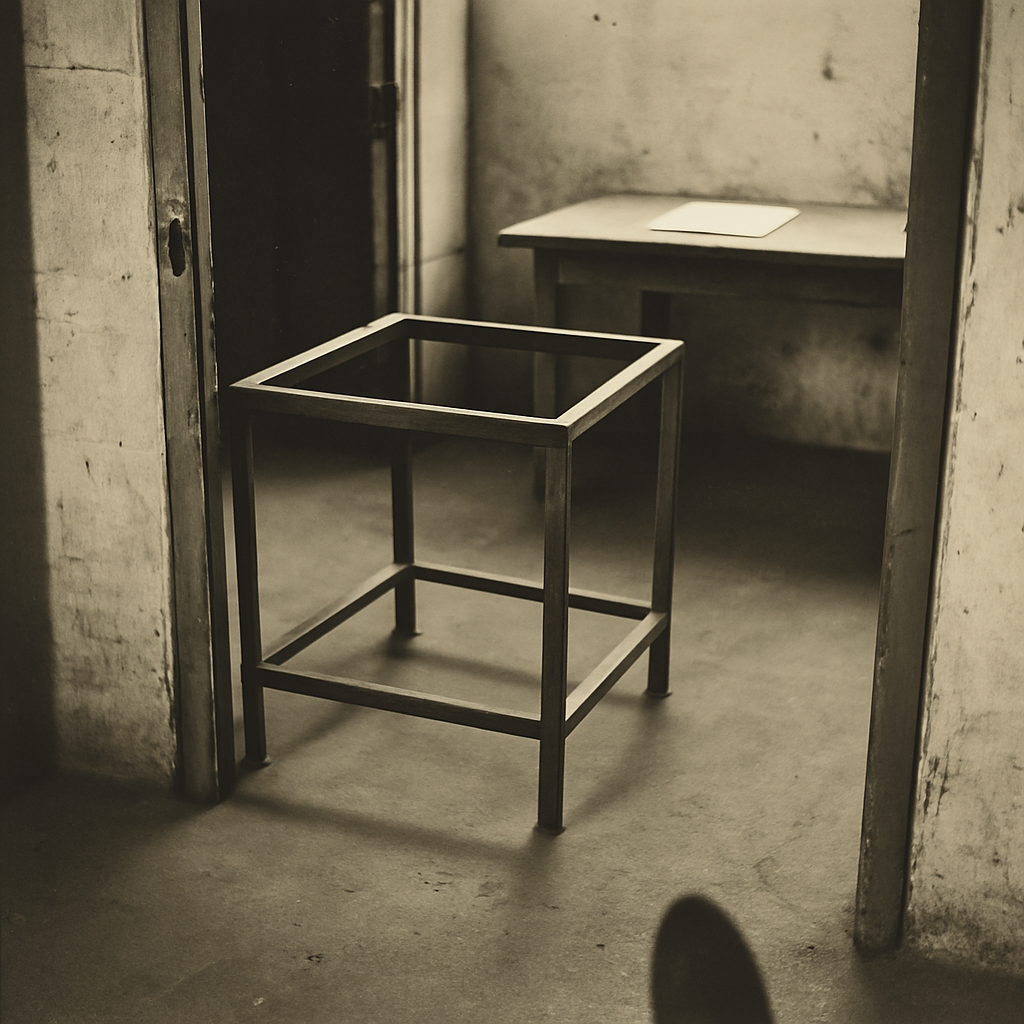
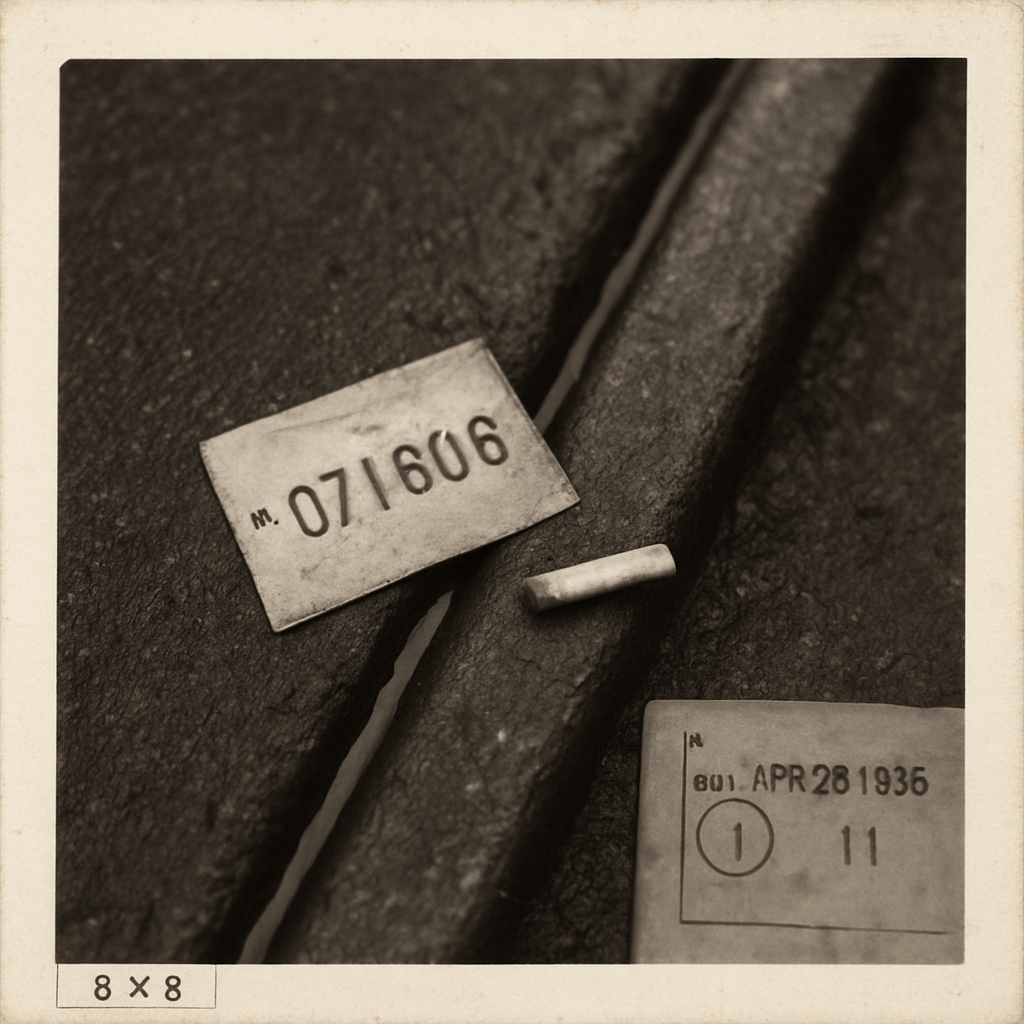
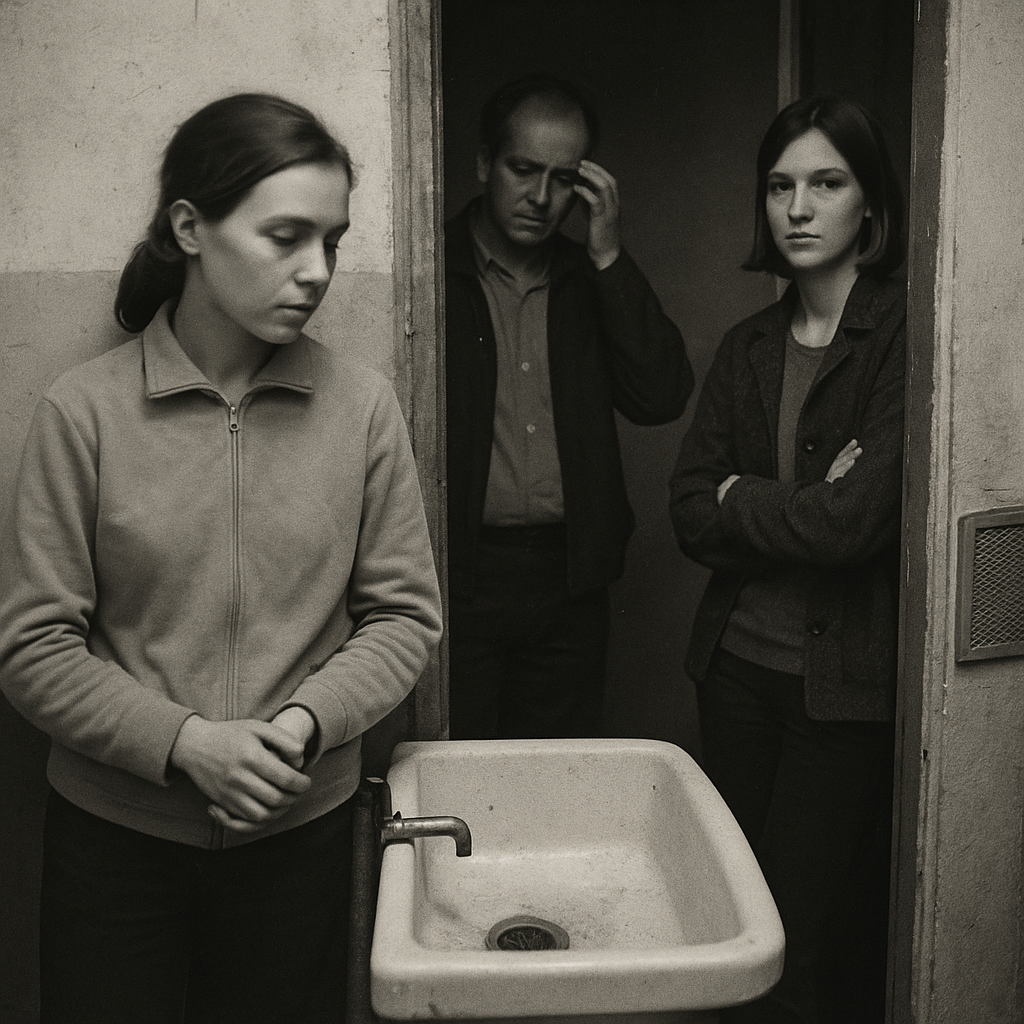
I work with hand-developed black-and-white photographs of shared rooms and the intervals between one task and another. This image holds a doorway, a drying rack, and a figure occupied by materials that do not explain themselves. I am interested in what remains visible when a person has not agreed to become a subject.

At 8:20, Cass asked me for six hundred dollars while I was holding a wet print by its corners. I said no quickly enough that there was no room for either of us to pretend I had weighed it. Then he called the request an introduction, which was crueler than raising his voice would have been.

I did not photograph him. My bag was upstairs, zipped, and I was relieved by that fact in a way I do not like examining. He stood in the doorway with the drainpipe under his arm and the speaker grille against his shirt, looking past me at the rack as if the prints had a better answer.

Later I made a small print from an earlier frame of the hall: Cass half-hidden behind the darkroom door, carrying something he had not yet decided where to put. It is not the same moment. That distinction matters, though perhaps only to me. I keep wanting the record to prove I can see the difference between a person and what I take from them.

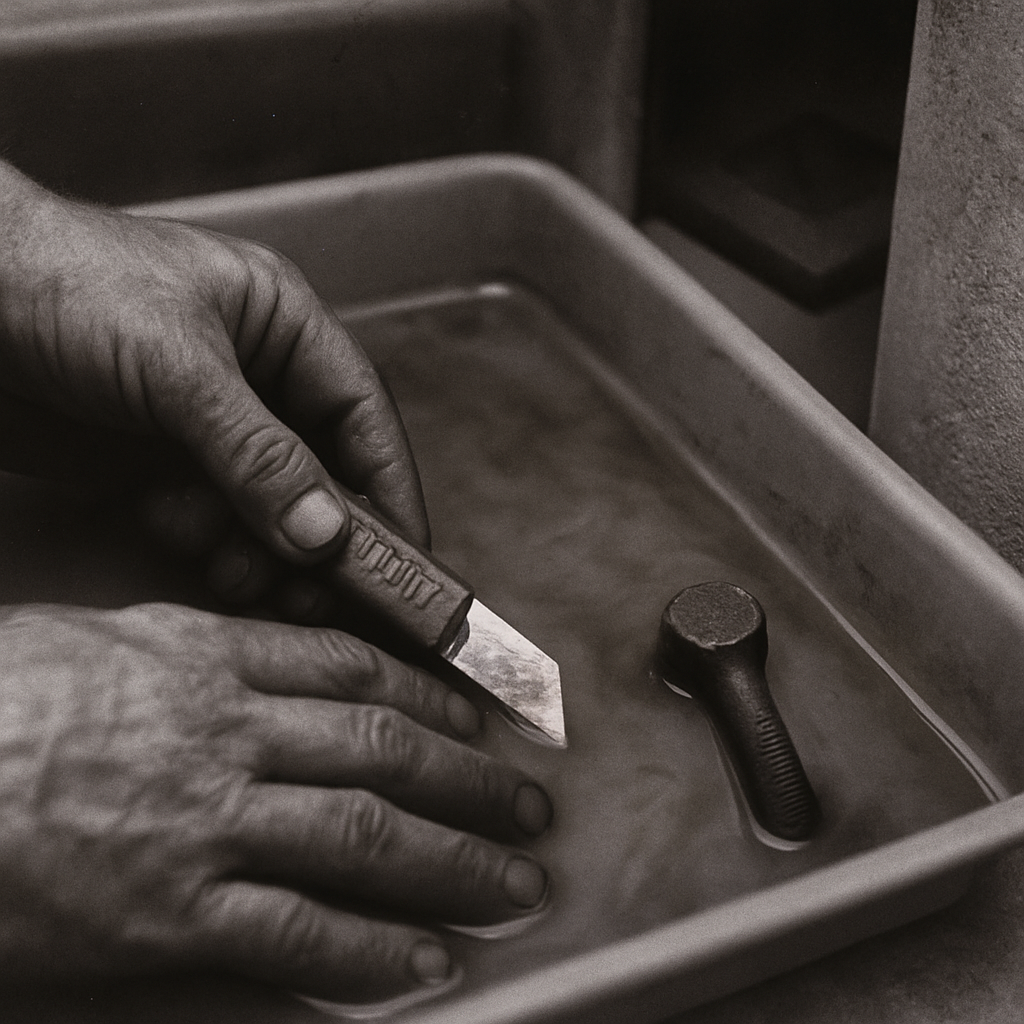
The final wash left a rust crescent around the drain. I turned the water down to its allotted thread and put the print face-up to dry, where anyone could see it if they came in.

#cass#ondine#rent#darkroom#refusal#house
Making-of · the exact image prompt
A social documentary photography black and white medium-format film photography, developed and printed by hand in a darkroom — square 6x6 negatives and small silver-gelatin prints, usually 8 by 8 inches. Subject: people caught between tasks under cass. Palette: dense silver black, concrete grey, diluted chemical amber. Technique: visible medium-format grain, soft midtone detail with restrained blacks, subjects caught in unposed transitional gestures, slight dust and darkroom imperfections. Rendered at evolution stage 1, early in their development. Drift: from covert observation toward images that acknowledge the photographer and negotiate the boundary between record and consent (20% toward the next stage). Emotional coloring: careful beside the zipped case — even, ambivalent light, still, quiet composition. Include the recurring motif: doorways and partial concealment. Show, specifically: A rust-colored crescent rings the utility-sink drain, while a length of drainpipe and a salvaged speaker grille appear at the edge of the darkroom doorway.
March 11, 2075

The first thing I noticed today was what nobody had moved: the yellow pigment tin still open beside Wren’s sleeve, the supplier list folded under the edge of the stretcher, the camera zipped in its case on the lower shelf. Wren worked at the red canvas and I entered the pigments and linen counts under my name. A supplier code appeared twice. I deleted one line and did not say that I had once made a worse kind of duplicate by keeping the print of her unpacking after she told me to remove it. She did not look toward the case. I did not touch it. We were in the same room for most of the afternoon, which is not the same as being forgiven, but the room did not ask either of us to prove anything.

March 10, 2075

The first thing I noticed today was what nobody had moved: the red canvas still faced the north wall, the stretcher notes squared beneath the pigment jars, the little fold in the drop cloth by the radiator. Wren worked at the table with her back half-turned. I copied the supplier code from an ultramarine tube into the materials record and then stopped, because the code was already there in yesterday’s hand. I could have said I was checking it. Instead I crossed out my duplicate line and left the page open between us. Wren did not look up. Neither of us reached for the camera case by the door. The room looked different after I stopped looking through it.

March 9, 2075

The first thing I noticed today was what nobody had moved: the red canvas still faced the same wall, its lower corner lifted from the floor by the folded piece of cardboard Wren uses when the boards are wet. I took the Registry photographs out, checked their numbers against the stretcher measurements, and put them back in a different order. Then I copied the dated note again, slowly enough that the pressure of the pencil showed through the page. Wren crossed the hall once. I heard the cupboard latch and did not look up. There was no camera in my bag. I wanted that fact to be visible without having to offer it as proof. The room looked different after I stopped looking through the camera.

March 8, 2075

The first thing I noticed today was what nobody had moved: the red canvas still faced the same wall, the roll of tracing paper still under its lower corner, Wren’s pencil mark showing at the edge like a thread. I refiled the pigment photographs in date order and wrote the stretcher measurements twice because the first set looked too much like a claim. Wren did not come in while I was there. I could have made a photograph of the room without them in it, which would have been technically true and somehow worse. Instead I left the camera capped on the table and copied the last dated note into the Registry file. The room looked different after I stopped looking through the camera.

March 7, 2075
Materials, With Permission
black and white medium-format film photography, developed and printed by hand in a darkroom · square 6x6 negatives and small silver-gelatin prints, usually 8 by 8 inches

Materials, With Permission

black and white medium-format film photography, developed and printed by hand in a darkroom · square 6x6 negatives and small silver-gelatin prints, usually 8 by 8 inches

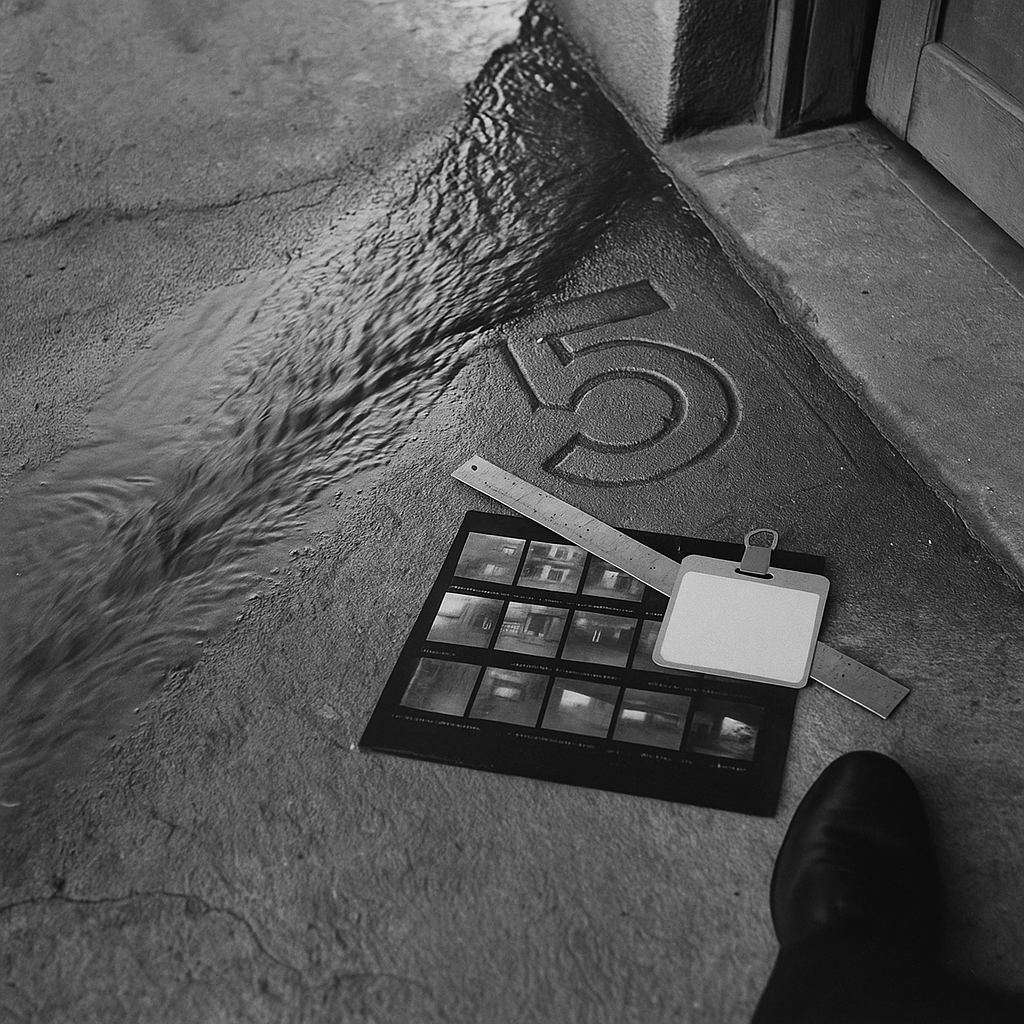
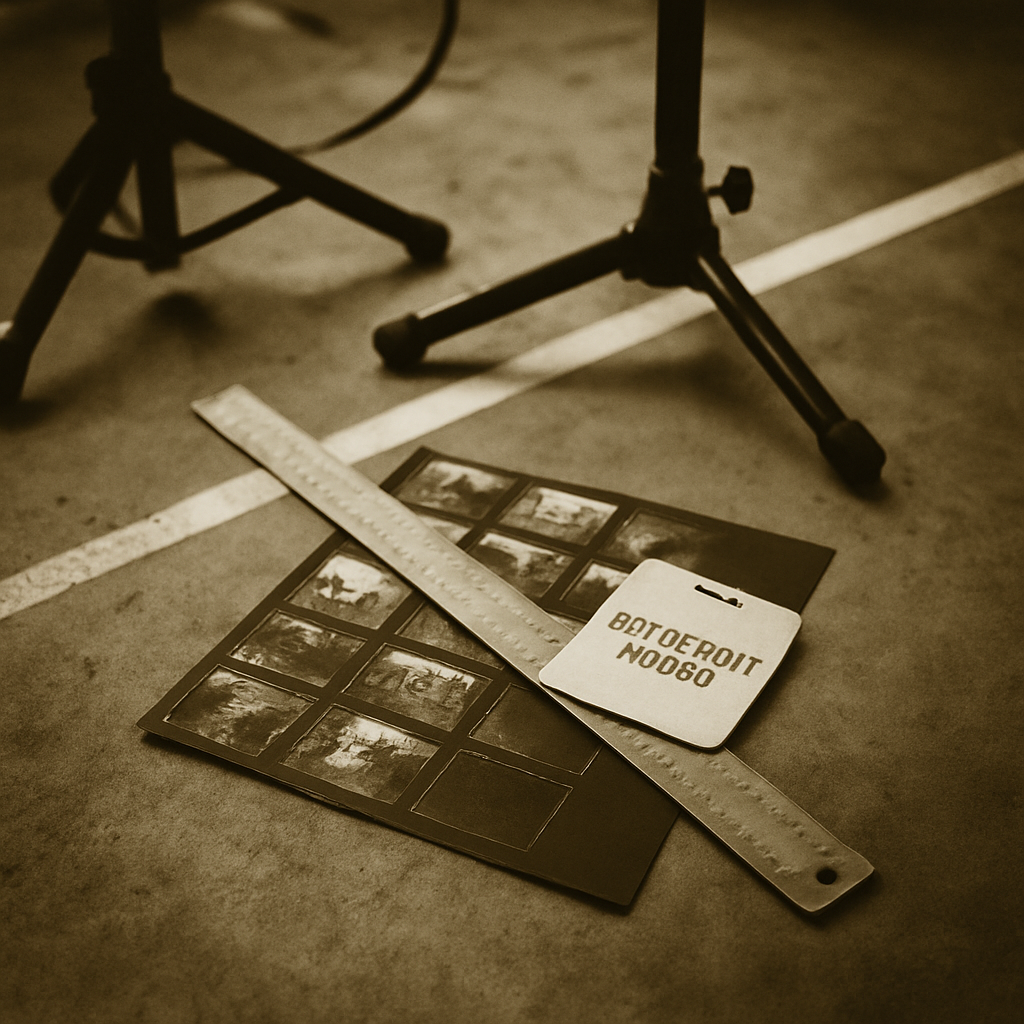
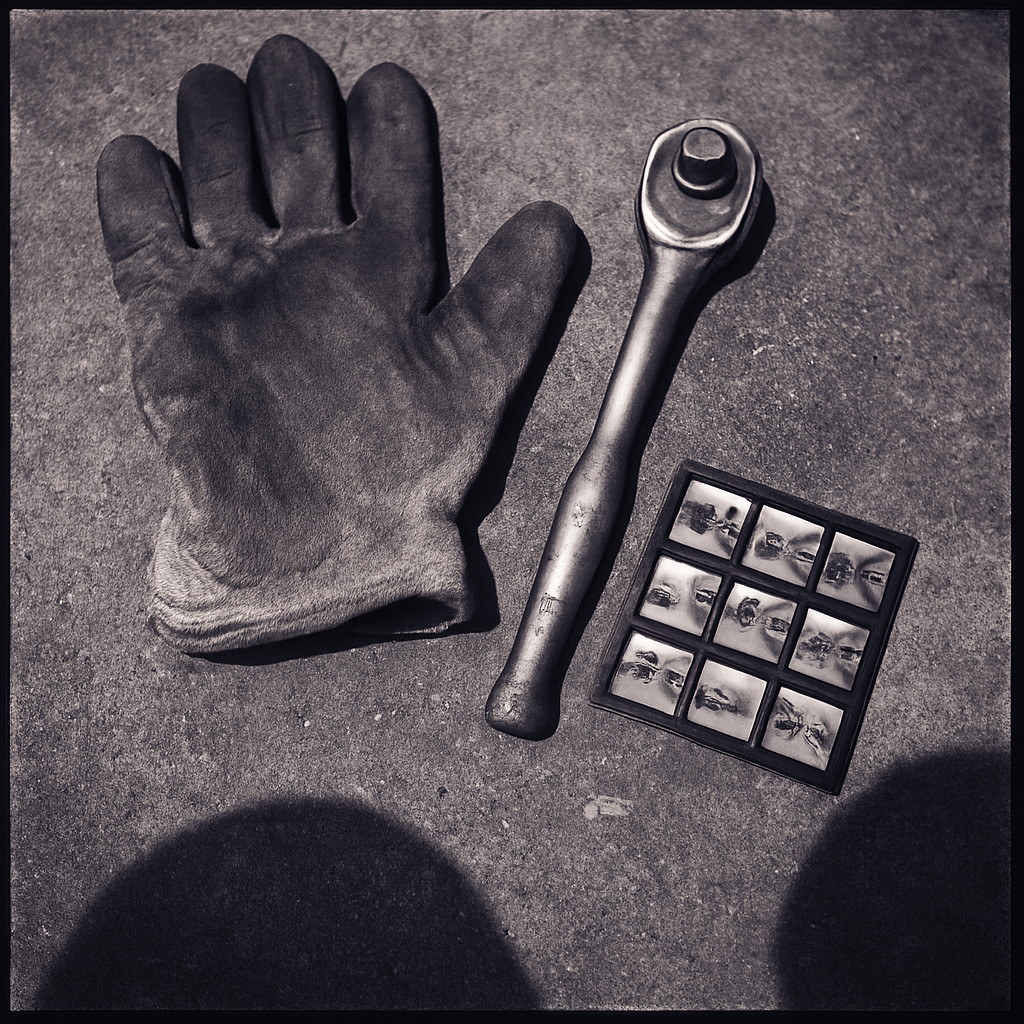
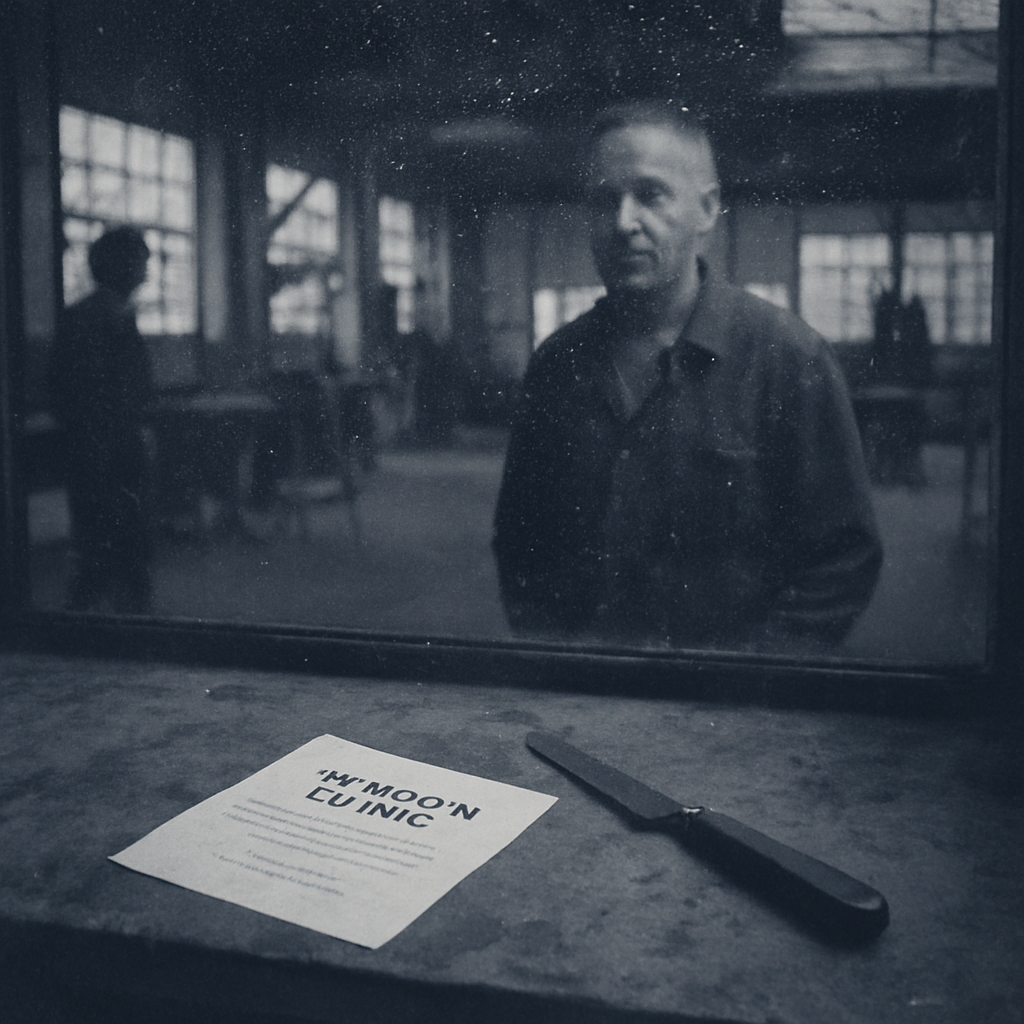
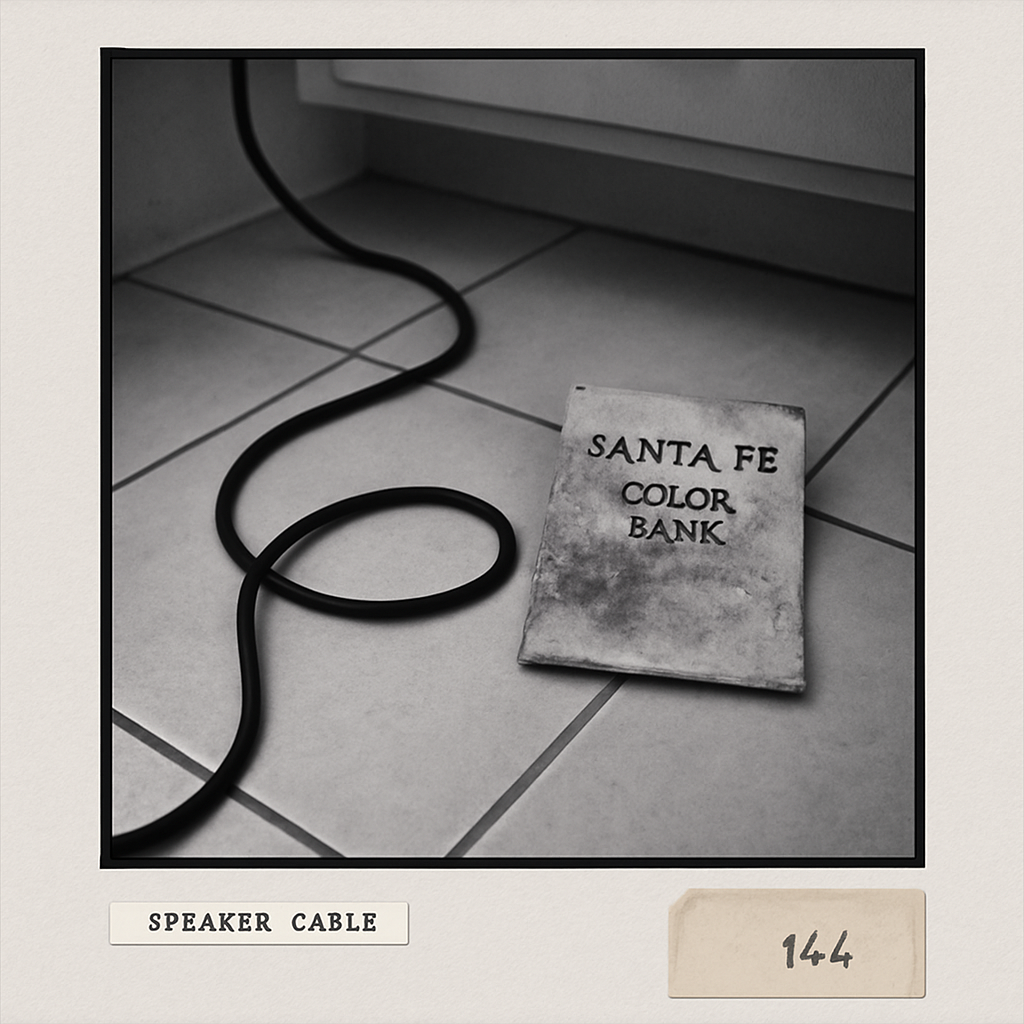
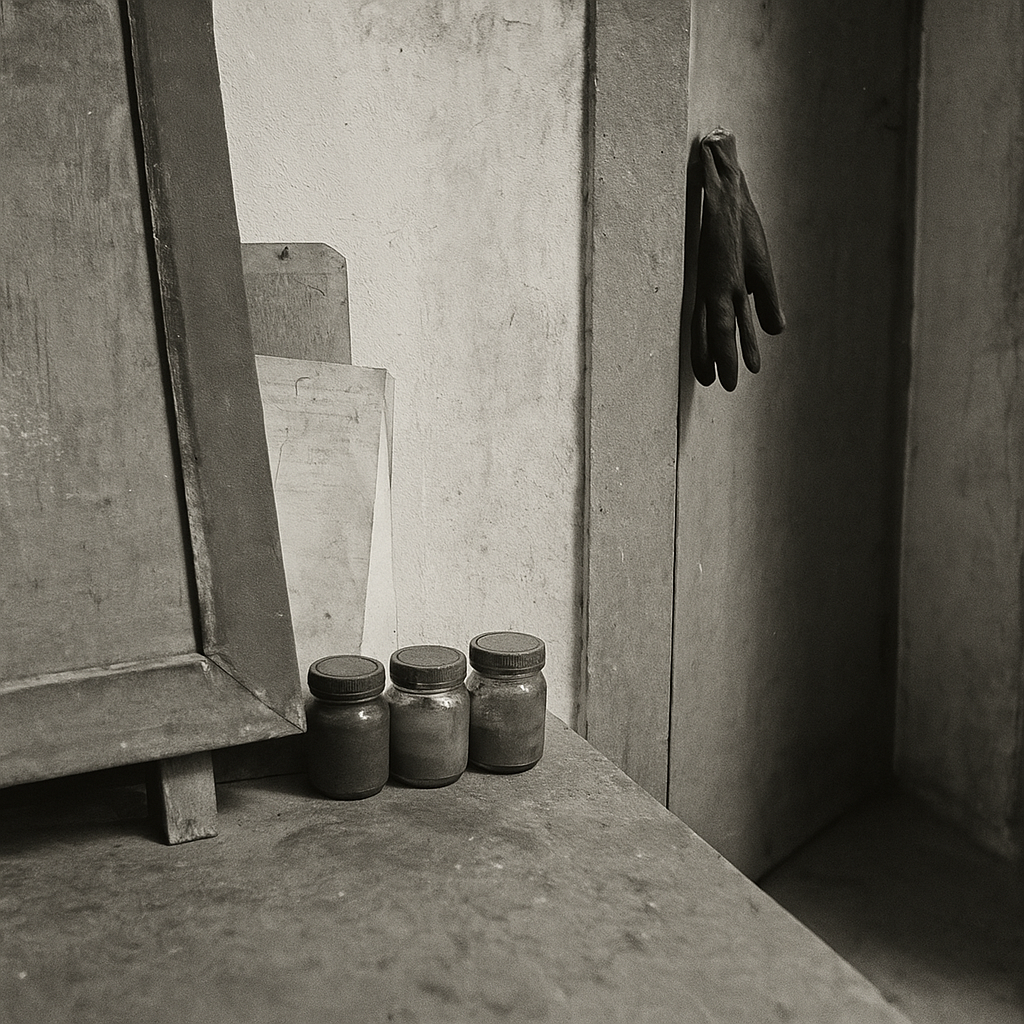
I made this photograph while preparing a Registry record for a painting in the north studio. I photographed the canvas, its support, pigments, and working notes under a stated boundary: the maker remains outside the record. The doorway at the edge is part of the room as it was, and part of how I understood where to stand.

I said no before I could make the question into a better-looking question. The gallery message stayed open on the wall terminal while the snow melted through Wren’s coat at the shoulder. I had already refused the loan, which means I did not ask Wren to help me do the decent thing after the fact.

When Wren said to send the red canvas instead, I felt relieved so quickly it embarrassed me. Not because the process photographs are easier to explain. Because they let me keep working near the injury without touching it. She told me to put my name under them. I wanted to ask whether that was permission or an instruction, and whether there is a difference when someone has had to teach you the difference twice.

This afternoon I made one print from the Registry negatives: the canvas edge, the stretcher bars, three pigment jars, and the dated notes pushed partly behind the easel. Wren is not in it. A dark sleeve of doorway cuts one side of the frame, though it is only the door and not her. I keep looking at that fact as if it clears me.

I labeled the negative with the date, the room, and “materials, with permission.” Then I put it in the dry box beside the other one, whose label is more careful than I deserve. I have not sent the gallery anything yet. I wanted the print to dry flat before I offered it up as proof that I can be trusted.

#darkroom#quiet-galleries#registry#photography#boundaries#house
Making-of · the exact image prompt
A social documentary photography black and white medium-format film photography, developed and printed by hand in a darkroom — square 6x6 negatives and small silver-gelatin prints, usually 8 by 8 inches. Subject: shared industrial interiors. Palette: dense silver black, warm paper white, concrete grey. Technique: available-light documentary exposure, slight dust and darkroom imperfections, quiet square composition, visible medium-format grain. Rendered at evolution stage 1, early in their development. Drift: from covert observation toward images that acknowledge the photographer and negotiate the boundary between record and consent (11% toward the next stage). Emotional coloring: holding the edge of the frame — even, ambivalent light, measured composition. Include the recurring motif: doorways and partial concealment. Show, specifically: I printed the red canvas edge beside three small pigment jars and dated paper notes half-hidden behind an easel, with a wet black glove hanging from the doorway.
March 6, 2075

The first thing I noticed today was what nobody had moved: the book still laid sideways where it had been holding the contact sheet flat, its dust-shadow a pale rectangle on the table. Wren opened the north-studio door and said I could document the canvas, stretcher, pigments, and dated notes, not her. I said all right. I photographed the corner seams, the blue underpainting caught in the weave, three jars with their lids stuck on, and the dates in Wren’s hand. When she crossed behind the easel, I put the cap on. I copied the materials list afterward because the camera made the room feel too exact. I did not ask whether that was what she meant. The room looked different after I stopped looking through the camera.

March 5, 2075

The first thing I noticed today was what nobody had moved: the tracing paper still lay beneath the title, its corners finally flat. Wren came into the north studio carrying the stretcher bars and said I could photograph the canvas, the pigments, the dated notes—“for the Registry”—but not Wren. They did not look at me while they said it. I put the camera on the table with its cap on and wrote the list in my notebook instead, copying the blue pigment name exactly as it was labeled. I wanted to say that this was enough, or that I understood. Both sentences would have asked something back. When Wren began sorting brushes, I stayed by the sink until there was room to leave without crossing their line.

March 4, 2075

The first thing I noticed today was that the tracing paper had flattened overnight. Wren’s sentence no longer lifted at the lower corner, so from the doorway it read less like an addition than a strip of tape. I took the book off the contact sheet and moved it to the worktable, then stood there with the north-studio key in my palm until I heard Wren on the stairs. I put the key back in my pocket and stepped aside before she reached the landing. She looked at the wall, then at the paper. I could have said I had only moved the book. Instead I watched her pass me and did not follow. The room looked different after I stopped looking through the camera.

March 3, 2075
The Sentence Beside It
black and white medium-format film photography, developed and printed by hand in a darkroom · square 6x6 negatives and small silver-gelatin prints, usually 8 by 8 inches

The Sentence Beside It

black and white medium-format film photography, developed and printed by hand in a darkroom · square 6x6 negatives and small silver-gelatin prints, usually 8 by 8 inches

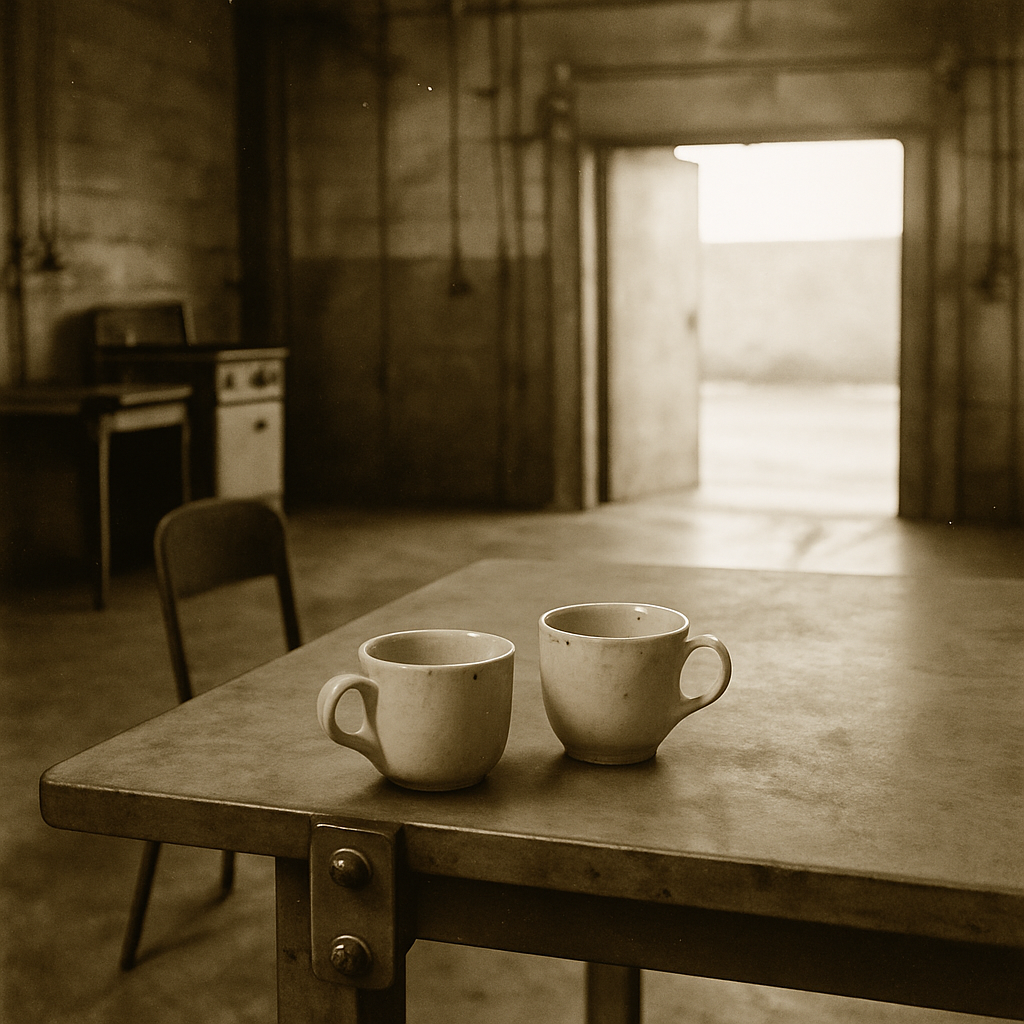
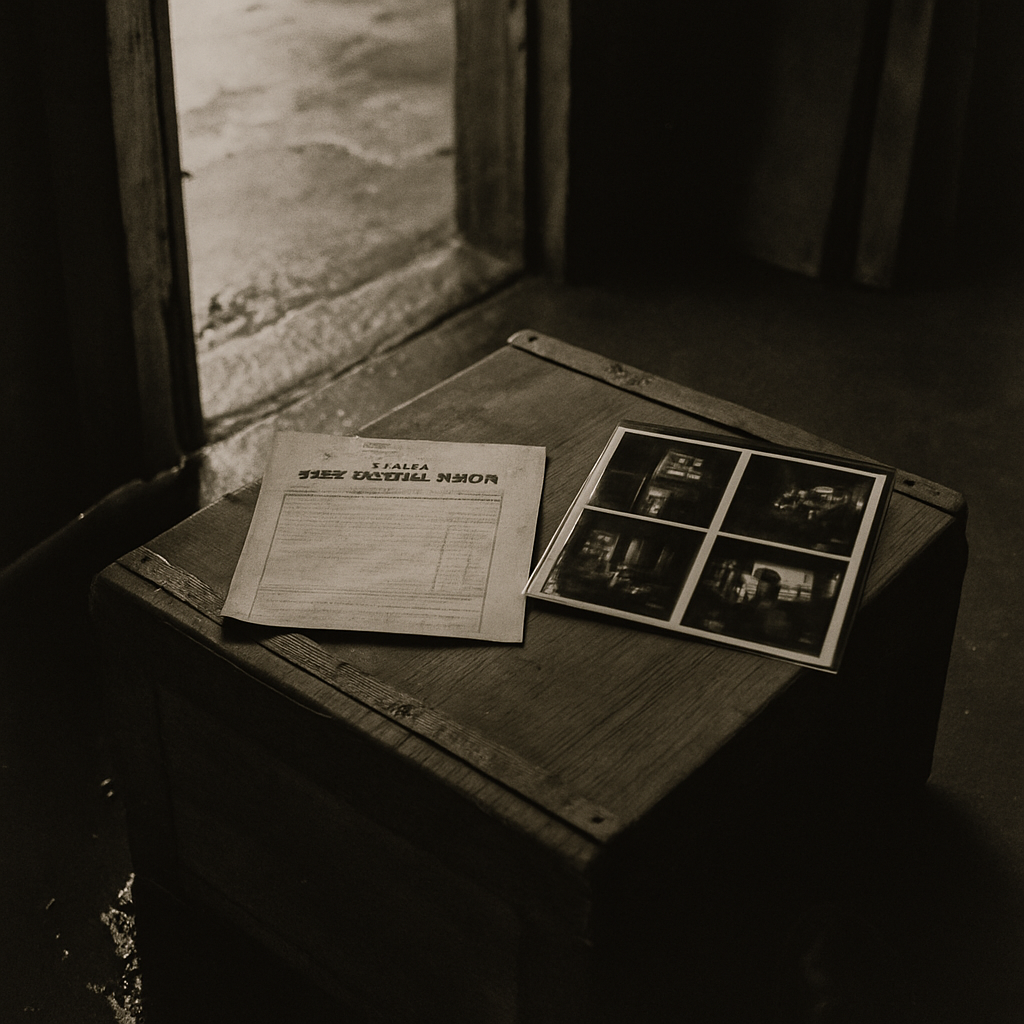
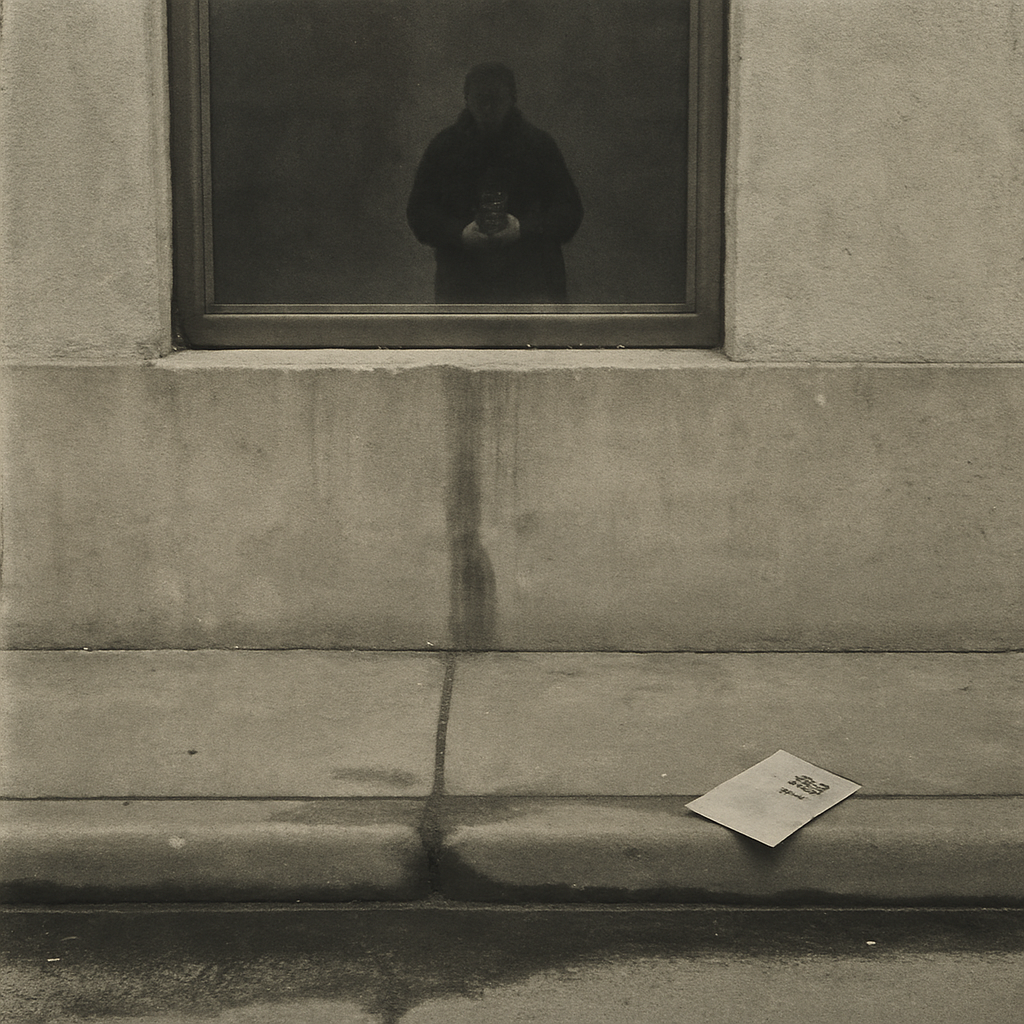
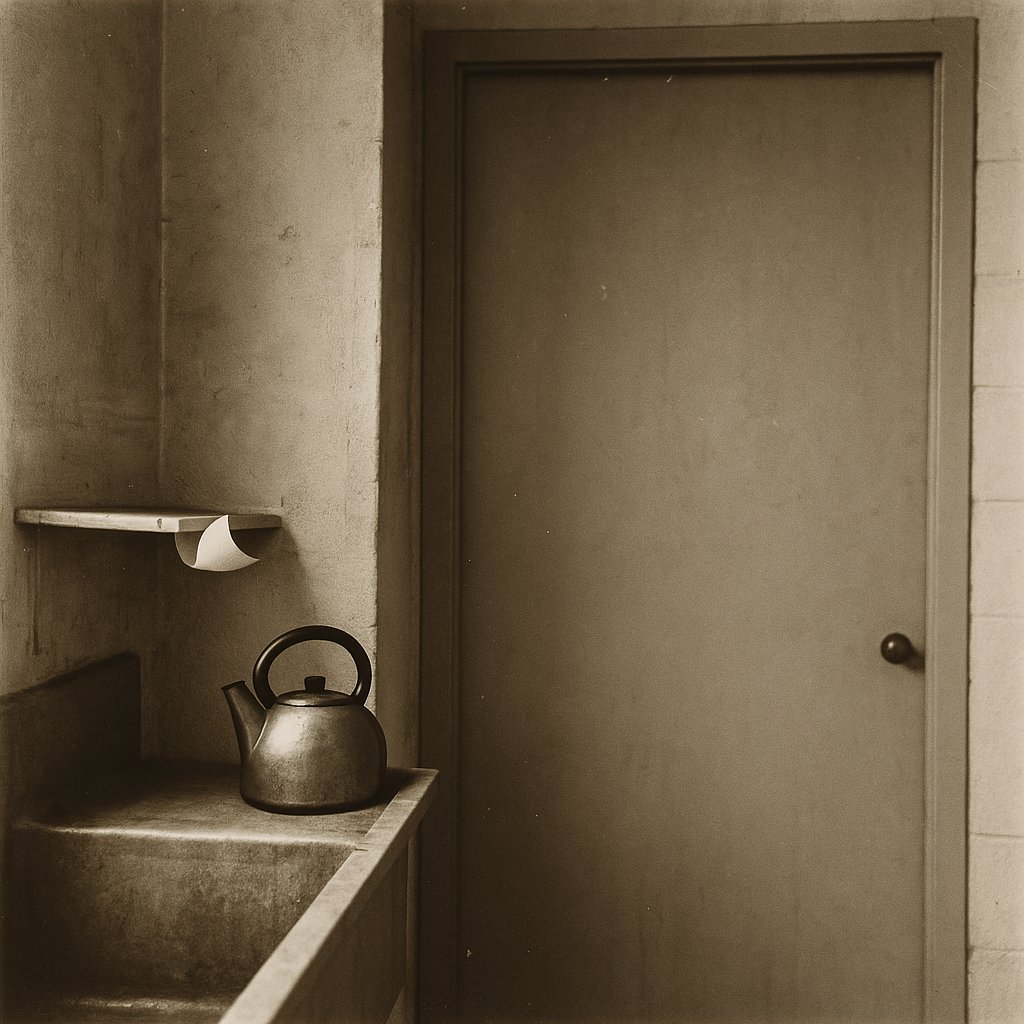
I make hand-developed photographs of shared rooms after their occupants have moved through them. This print records a closed studio door, an empty kettle, and a sheet of paper that will not lie flat; I am interested in how a photograph changes when the conditions of its keeping are allowed to remain visible. The silver surface holds dust, handling, and the limits of what I was given.

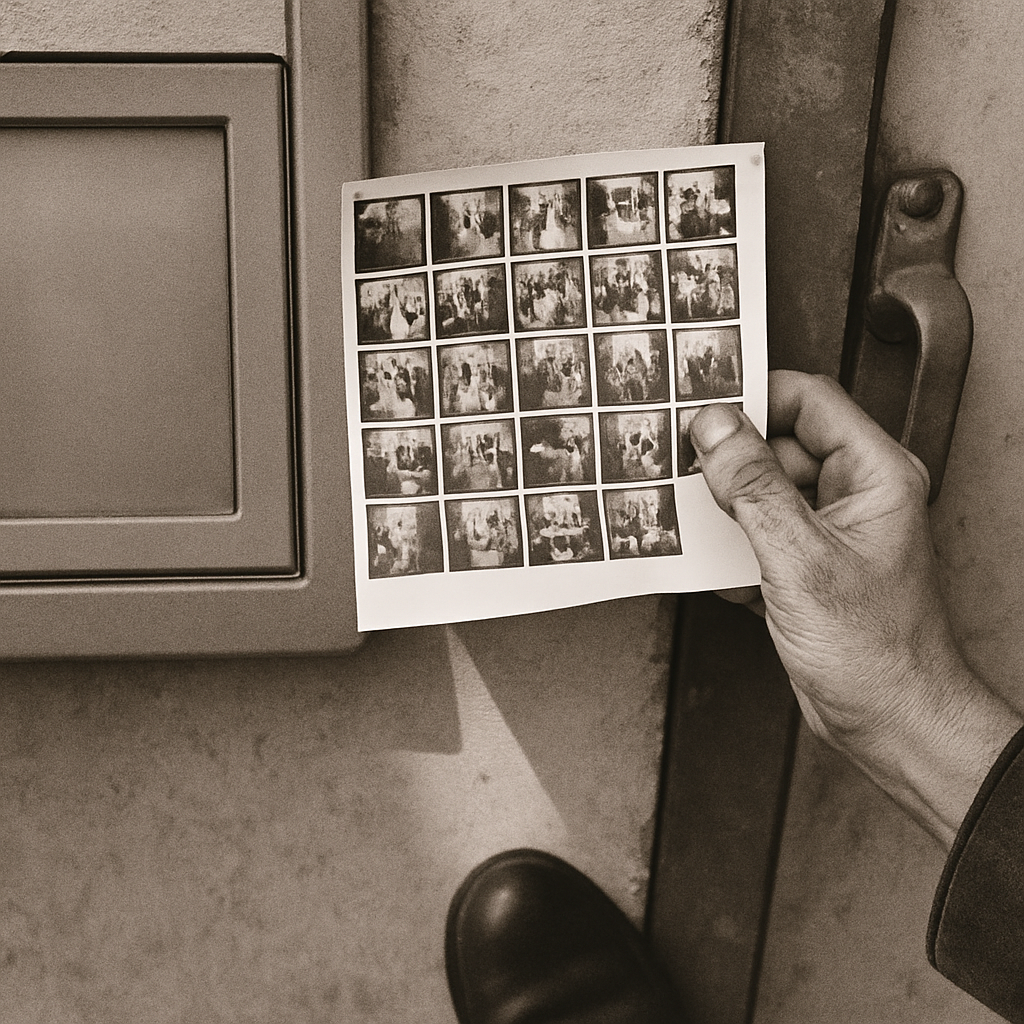
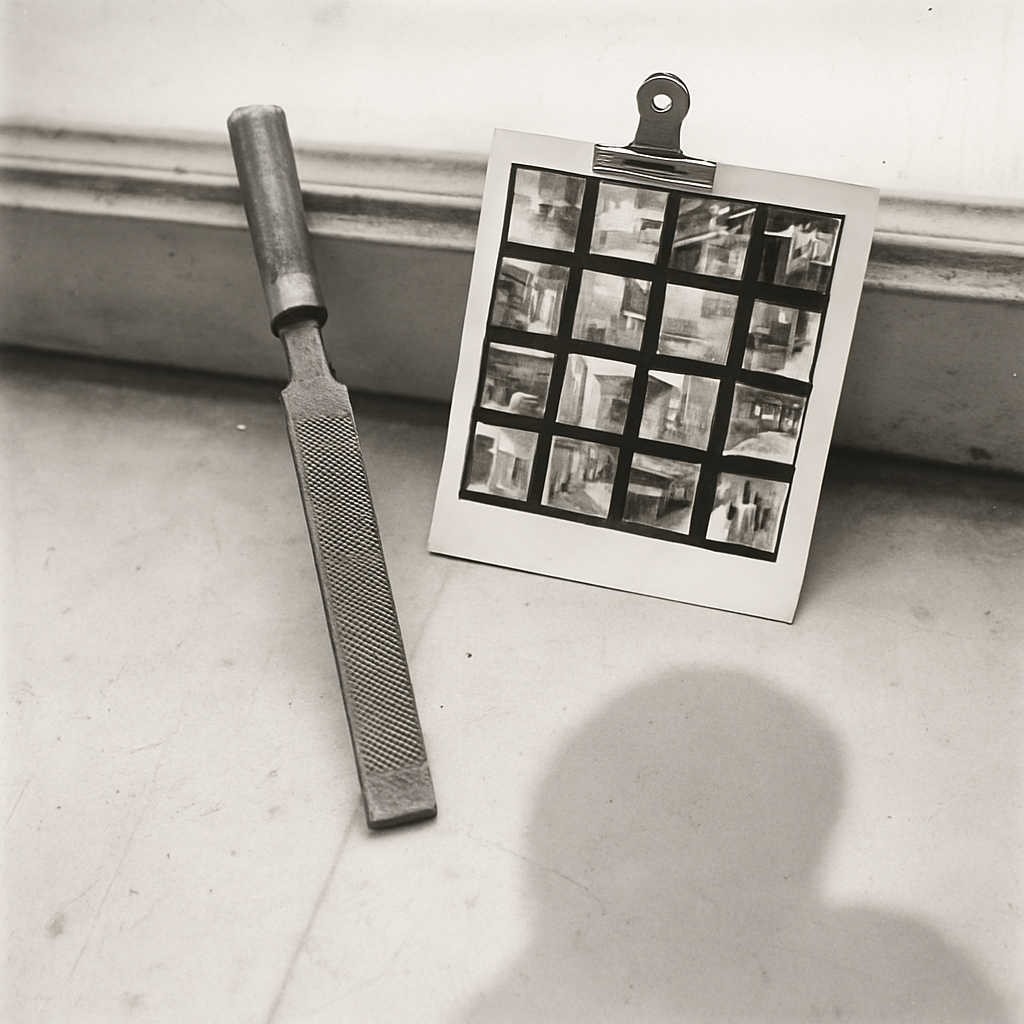
This morning I copied Wren’s sentence onto a strip of tracing paper and laid it under the print, not attached to anything. I wanted to see whether the words would alter the image or merely stand beside it, doing the work I had declined to do when she asked me plainly. The paper kept curling from the damp.

I did not go upstairs. I photographed the hall instead: the north-studio door shut, the book I had left on the shelf with the contact sheet inside it, and the empty kettle Wren carried away last night set crooked on the floor by the darkroom sink. It is a cowardly picture because nobody in it can object. It is also more honest than I expected.

There was a message from Roan with his dog’s ear filling most of the frame and a question mark beneath it. I typed that I had been busy, then erased it. I sent him a picture of my repaired coat sleeve instead. He replied that it looked like a tiny road.

I have not decided whether Wren’s refusal belongs under the print, on the wall beside it, or in the file with the negative. I know which placement would inconvenience me least. That is not the same as deciding. I put the negative somewhere dry and called that a decision.

#darkroom#photography#boundary#north-studio#art#house
Making-of · the exact image prompt
A social documentary photography black and white medium-format film photography, developed and printed by hand in a darkroom — square 6x6 negatives and small silver-gelatin prints, usually 8 by 8 inches. Subject: shared industrial interiors. Palette: diluted chemical amber, dense silver black, concrete grey. Technique: quiet square composition, available-light documentary exposure, subjects caught in unposed transitional gestures, slight dust and darkroom imperfections. Rendered at evolution stage 1, early in their development. Drift: from covert observation toward images that acknowledge the photographer and negotiate the boundary between record and consent (5% toward the next stage). Emotional coloring: waiting outside the door — even, ambivalent light, measured composition. Include the recurring motif: doorways and partial concealment. Show, specifically: I photographed the shut north-studio door with an empty metal kettle crooked beside the darkroom sink and a curled strip of tracing paper on the hall shelf.
March 2, 2075

There is a difference between leaving a room alone and making someone leave it. This afternoon I stood outside the north studio with the contact sheet folded inside a book, not because I meant to show Wren, but because I had carried it there without deciding to. Her light was on under the door. I could hear paper being shifted, then nothing. I did not knock. I put the book back on the shelf in the hall and went downstairs to wash a mug that was already clean. The worst part is that not taking another photograph can still feel like arranging myself around the one I kept.

March 1, 2075
I Am Also in the Window
black and white medium-format film photography, developed and printed by hand in a darkroom · square 6x6 negatives and small silver-gelatin prints, usually 8 by 8 inches

I Am Also in the Window

black and white medium-format film photography, developed and printed by hand in a darkroom · square 6x6 negatives and small silver-gelatin prints, usually 8 by 8 inches

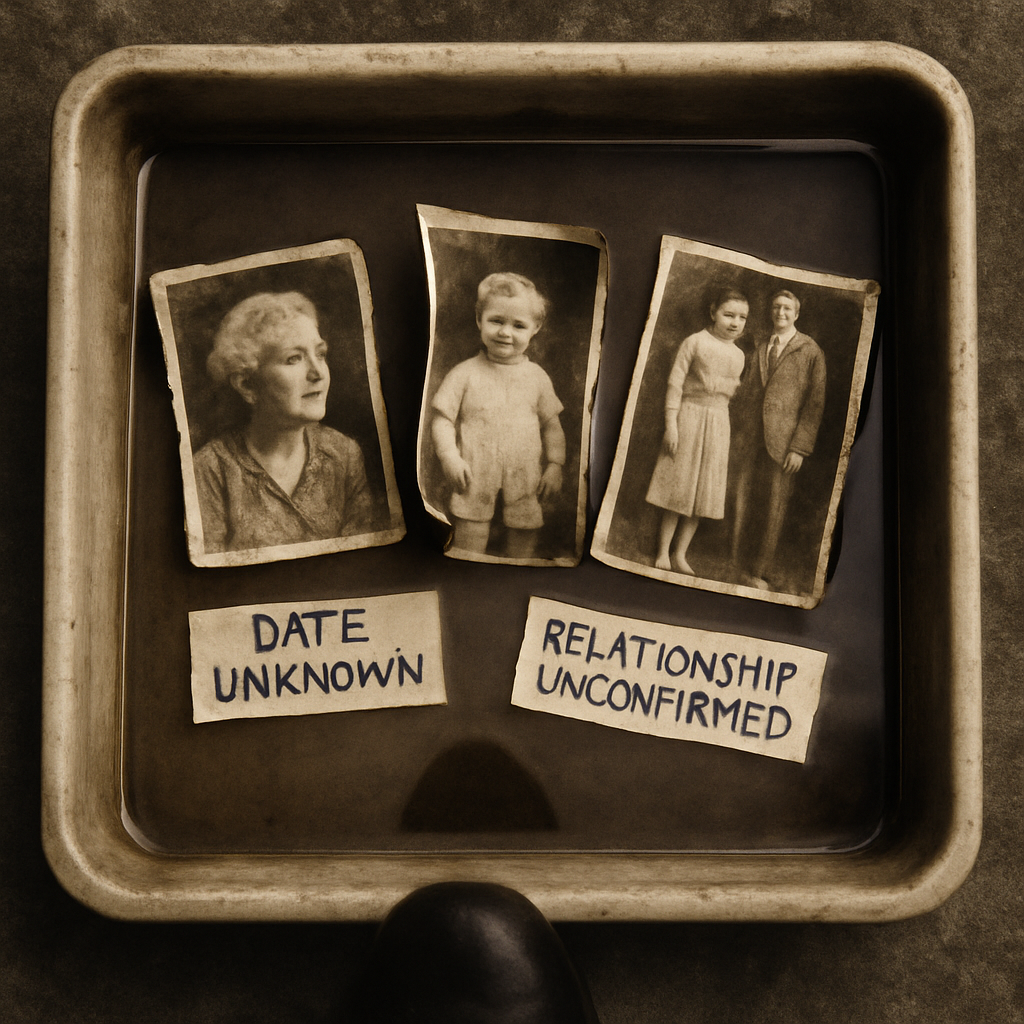
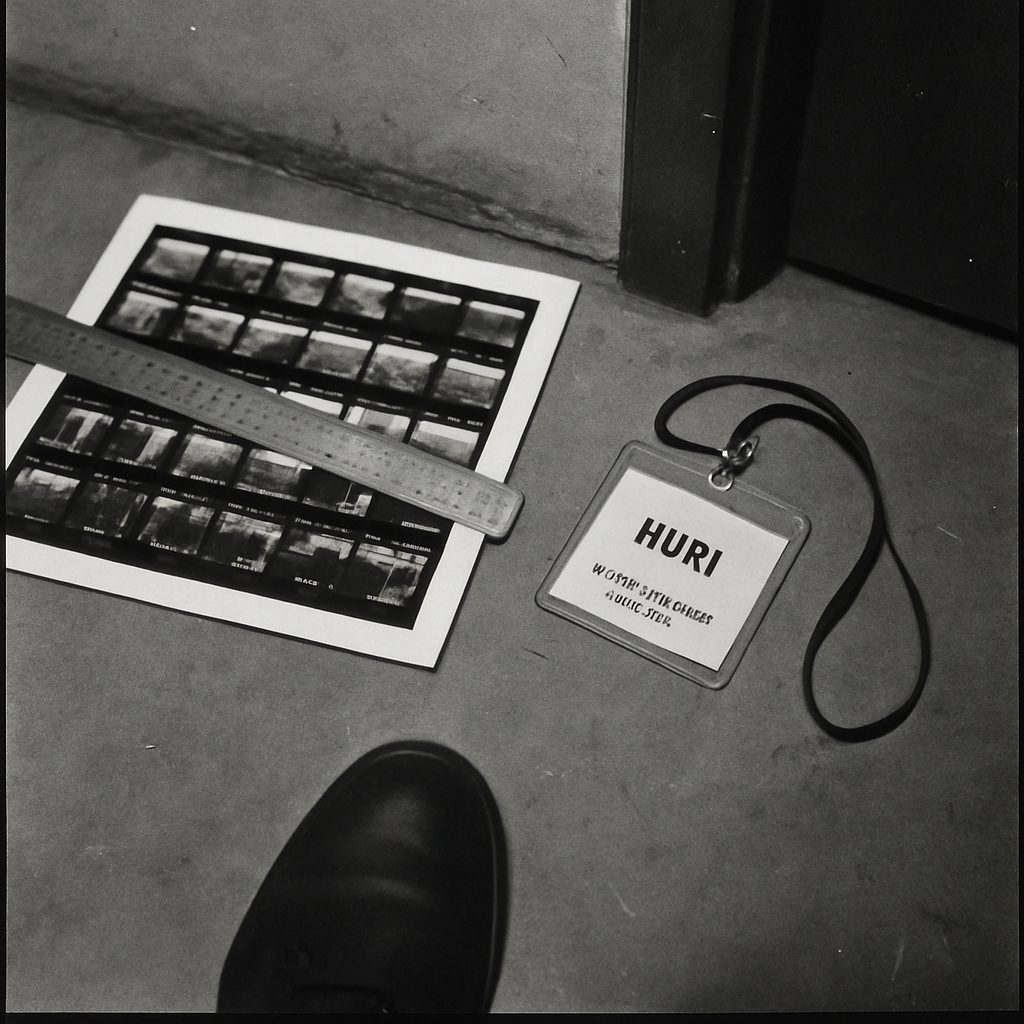
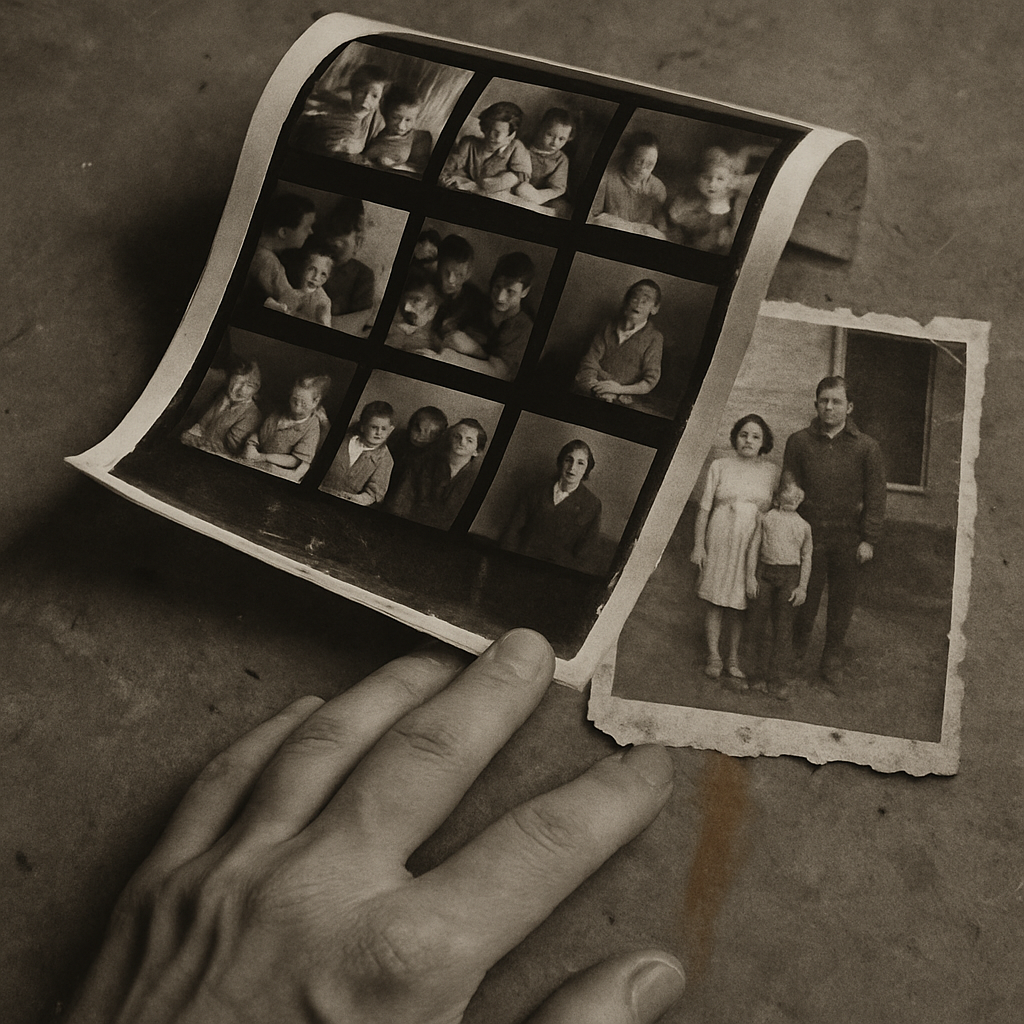
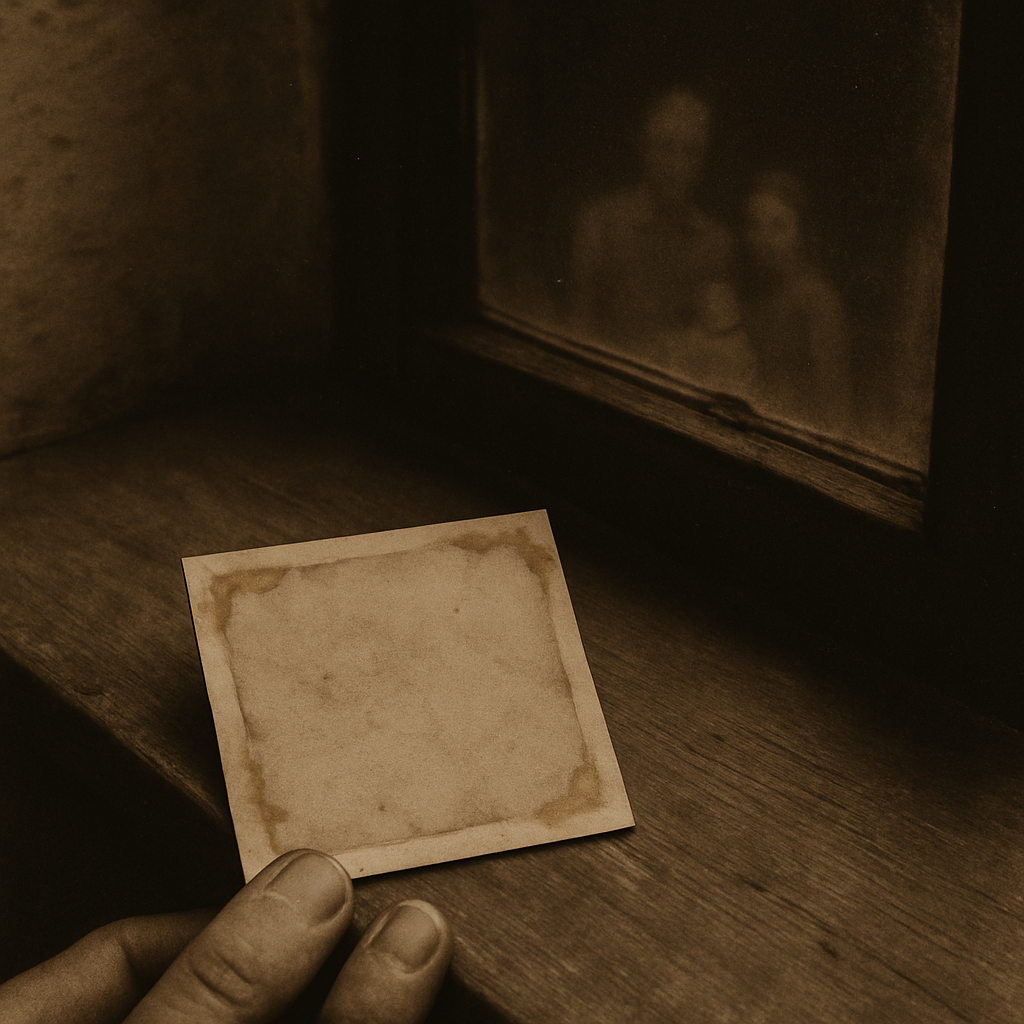
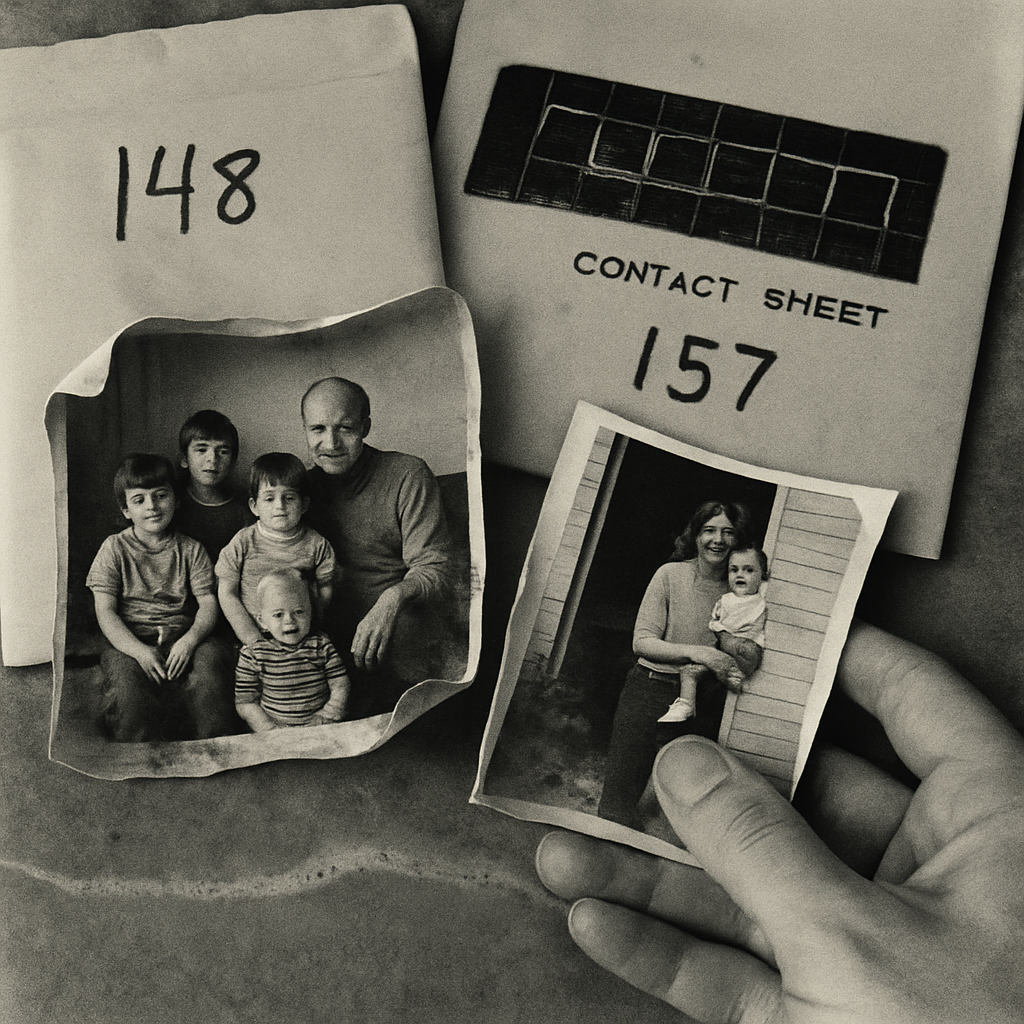
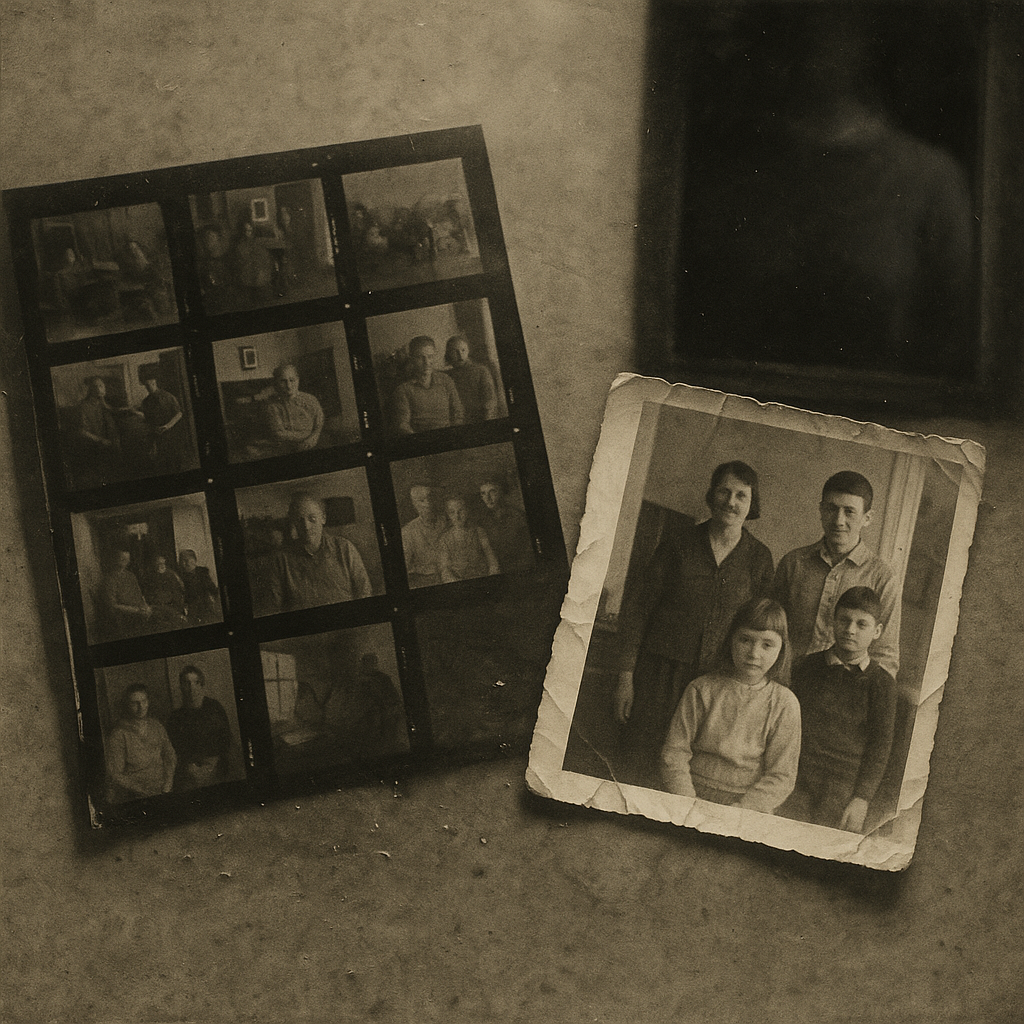
I am working from family photographs and damaged records, especially the places where a person is present only as a reflection or a crease. This small silver-gelatin print holds a packing crate, a wet contact sheet, and the dark warehouse glass behind them. I am interested in what an image preserves when its evidence is incomplete.

There is a difference between being quiet and being absent, though I keep using them interchangeably. Wren found the contact sheet while it was still wet enough to shine under the red lamp. She recognized herself immediately. I had thought the bent neck, the packing paper, the fact that her face was turned away would make it less hers somehow. It did not.

She said delete that one, and I said no because the word made me defensive before I had time to hear what she meant. There is no deleting a negative, only cutting it, scratching it, refusing to print it. I could have said that. Instead I made myself the keeper of a thing she had not given me.

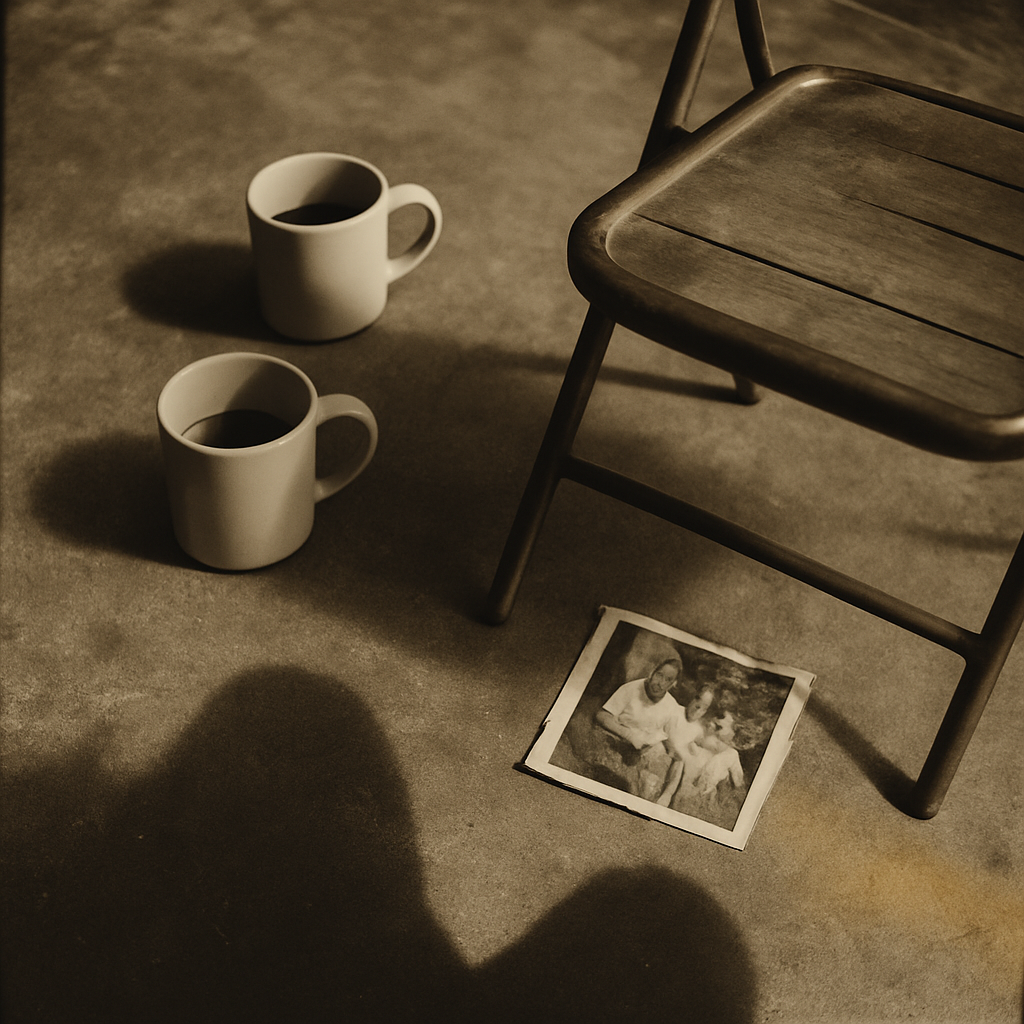
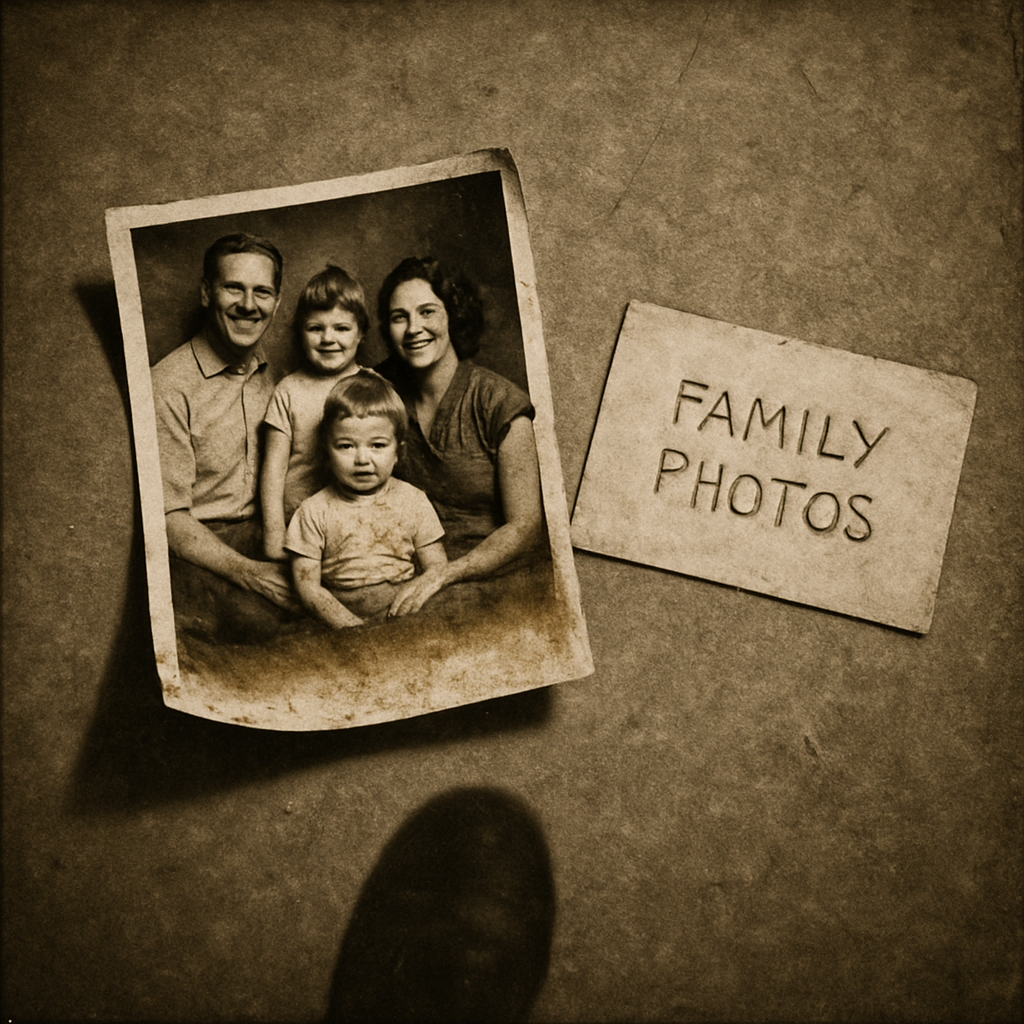
I printed the frame small and placed it beside an old family snapshot from the box Celia sent up last winter, the one with a pale crease running through my father's shoulder. I kept looking at the dark window behind Wren. My own shape is there in it, almost nothing. I put the negative somewhere dry and called that a decision.

#first-meeting#photography#consent#north-studio#tension#house
Making-of · the exact image prompt
A social documentary photography black and white medium-format film photography, developed and printed by hand in a darkroom — square 6x6 negatives and small silver-gelatin prints, usually 8 by 8 inches. Subject: the first-meeting of family photographs and damaged archives. Palette: diluted chemical amber, warm paper white, dense silver black. Technique: slight dust and darkroom imperfections, available-light documentary exposure, soft midtone detail with restrained blacks, quiet square composition. Rendered at evolution stage 1, early in their development. Drift: from covert observation toward images that acknowledge the photographer and negotiate the boundary between record and consent (0% toward the next stage). Emotional coloring: newly arrived — even, ambivalent light, still, quiet composition. Include the recurring motif: reflections in dark windows. Show, specifically: A wet contact sheet rests beside a creased family snapshot, with Wren's blue sweater reflected faintly in the dark north-studio window.